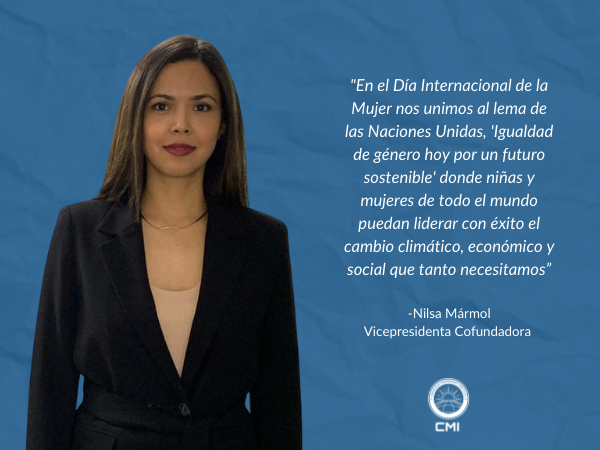
On this day of claiming rights, CMI’s deputy director and co-founder Nilsa Mármol shared some encouraging words.
CMI Business School marks this important day and calls for greater awareness of women’s struggle for equity, participation and empowerment in every part of society.
Nilsa Mármol Paulino, CMI’s deputy director and co-founder, said that “on International Women’s Day we join the United Nations theme, «Gender equality today for a sustainable tomorrow», in which girls and women across the world can successfully lead the climate, economic and social change we so badly need”.
“At CMI Business School we argue for leadership free of ego, conscious and grounded in values,” Mármol Paulino concluded.
A Sustainable Development Goal
The United Nations’ fifth Sustainable Development Goal (SDG), “Achieve gender equality and empower all women and girls”, is one of the 17 established in 2015. It focuses on empowering women and girls in order to end gender inequality, so as to avoid the social stagnation that inequality produces.
CMI Business School, which takes the challenges of SDG 5 as its own, joins this day of advocacy for another year and confirms its commitment to equality.
Some facts about the date
- That the day falls on 8 March is closely bound up with the feminist movements of the Russian Revolution of 1917.
- New Zealand was the first country to give women the vote, in 1893.
- In the 1920s, in the first known campaign of its kind, the Egyptian Doctors’ Society challenged tradition by setting out the harmful health effects of female genital mutilation. (Source: United Nations.)
International days
The United Nations devotes particular days to marking specific events or subjects, so as to advance the organisation’s aims through awareness and action. Such commemorations are generally proposed by member states and approved by the General Assembly through a resolution.