To understand how CSR and sustainability have evolved across different stakeholder groups, Corresponsables has produced a report drawing on more than a hundred experts in the field from eight Ibero-American countries. Focused on academia, one of the major challenges the study identifies is the low level of communication between companies and academic institutions — a significant factor that weakens innovation and development within corporations.
At a moment when sustainability and CSR are becoming central pillars of corporate strategy, one critical element appears to be lagging behind: collaboration with the academic world. The 2023 Corresponsables Report sheds light on this disconnect, revealing that dialogue between companies and academic institutions is surprisingly limited, rated as low by 46% and as moderate by 45%.
Although the most recent UNESCO report shows that collaboration between industry and academia on sustainability projects has grown by 20% internationally over the past five years, the poor dialogue with academic institutions revealed by the 2023 Corresponsables Report points to a significant missed opportunity for business.
The OECD makes the same point, stressing the importance of collaboration between the private sector and academic institutions, particularly in developing sustainable solutions. Companies engaged in R&D partnerships with universities tend to be further ahead in innovation and in adopting sustainable practices. Collaboration rates vary considerably between regions and sectors, however, which points to a gap in the take-up of this valuable practice.
Several bodies confirm the same premise: the greater the interaction between companies and academia, the greater the innovation and sustainable development.
According to a European Commission study, companies that work with academic institutions report 35% more successful sustainability innovations than those that do not. The Global Reporting Initiative (GRI) likewise finds that companies with strong academic ties are 30% more likely to meet their sustainability targets.
Companies should therefore take a more proactive approach to seeking out academic partnerships. According to the experts consulted, that might include creating scholarship programmes, entering into research and development partnerships, and bringing academics onto sustainability advisory boards.
Embedding social responsibility in the academic world
The 2023 Corresponsables Report also examines how social responsibility (SR) is being applied within academic institutions. The study found that 15% of respondents consider the integration of SR in academia to be high, while 57% rate it as moderate, 26% as low and 2% as non-existent. These figures suggest that SR is being embedded unevenly across academic institutions, which raises important questions about how and why such variation arises.
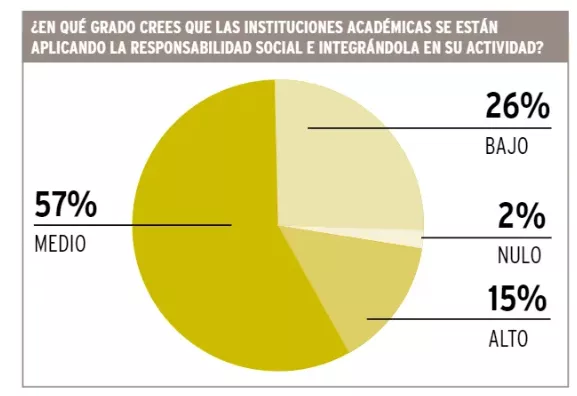
The perception that SR is only moderately or poorly embedded in most academic institutions suggests that, while its importance is recognised, there is still considerable room for it to be fully incorporated into everyday practice and policy. Experts attribute this to a range of factors: a lack of resources, the absence of a clear strategy, or a limited understanding of how to put SR principles into practice effectively in an academic setting.
Social responsibility in academia is not only a matter of teaching and research on related topics. It also means managing an institution’s own operations responsibly, working towards social inclusion, and engaging with the wider community.
Despite these challenges, there are notable examples of institutions that have successfully placed SR at the heart of how they operate. According to respondents, such cases tend to share certain features: SR is built into the curriculum, research is encouraged in areas related to sustainability and ethics, and operating policies reflect those same principles — environmental sustainability on campus, and ethical employment practices.