José María Berganza García / Lecturer at CMI Higher Education
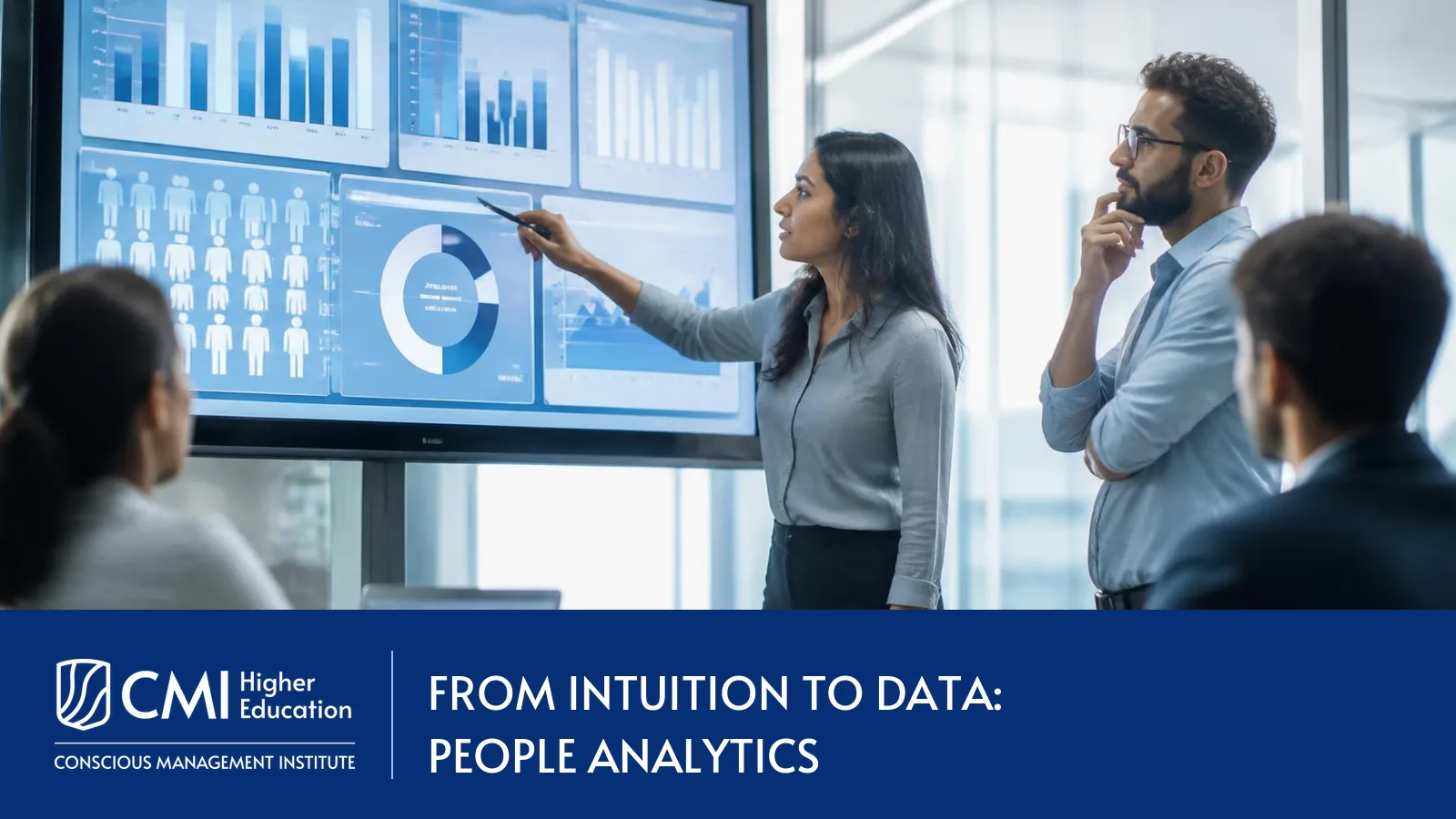
For decades, many human resources decisions have relied on managers’ experience, intuition or basic descriptive indicators. That experience is still valuable, but organisations now hold so much information about their people that they can ask far more precise questions: what explains staff turnover? Which profiles progress best? Which teams are most at risk of absenteeism? Which training is genuinely linked to better performance? People Analytics grows out of precisely this shift: using data, analytical methods and evidence to understand workforce behaviour better and to make better decisions.
This is not simply about building dashboards. Marler and Boudreau (2017) define HR Analytics as a practice aimed at demonstrating the links between people data and organisational outcomes. In practice, it can work at several levels. Descriptive analysis shows what has happened; diagnostic analysis seeks to explain why; predictive analysis estimates what might happen; and prescriptive analysis tries to point to the decision most likely to produce a better result. What matters is not having more data, but turning a business question into a testable hypothesis.
From technical specialism to strategic capability
These practices are now widespread. In an international study by the Chartered Institute of Personnel and Development covering 3,852 professionals, 75% of respondents said they used people data to address workforce performance and productivity (CIPD, 2018). That helps explain why People Analytics has moved from a technical specialism to a strategic capability. It can help identify turnover patterns, analyse how effective recruitment is, study pay gaps, evaluate training programmes or segment development needs. Moving from measurement to causation, however, calls for caution: the fact that two variables are associated does not mean that one causes the other.
Promise versus evidence
In fact, the scientific literature urges us to temper technological enthusiasm. A systematic review by McCartney and Fu (2022), based on 46 peer-reviewed articles published in 26 academic journals, identified a gap between the promise of People Analytics and the available evidence of its impact. The main problems include a lack of analytical skills, difficulty demonstrating value, ambiguity over who should lead these initiatives, and ethical and privacy risks. Tursunbayeva, Di Lauro and Pagliari (2018) had already noted that the published evidence for many of the claimed business benefits was still limited.
A mature implementation should therefore start with the quality of the questions, not with the tool. Before building a model to predict voluntary resignations, for example, it is worth defining what decision will be taken with that information, what level of error the organisation can live with, and what the consequences of misclassifying a person would be. Data quality, analytical design and interpretation come next. A sophisticated algorithm applied to incomplete, biased or poorly defined data can create an appearance of objectivity without actually improving the decision.
An unavoidable ethical dimension
Employee data can include appraisals, digital interactions, absenteeism, productivity or career histories. The review by Tursunbayeva et al. (2021) warns of risks around privacy, transparency, surveillance and the possible harm caused by inferences about workers. Governance must therefore include data minimisation, a legitimate purpose, access control, explainable models and human oversight.
The real value of People Analytics lies not in replacing managerial judgement with a formula, but in improving that judgement through evidence. An organisation that learns to ask good questions, tell correlation from causation, measure rigorously and discuss the results with the people who know the context turns data into knowledge. At that point, Human Resources stops merely reporting on what has happened and starts playing a stronger part in decisions about the organisation’s future.
References
- Chartered Institute of Personnel and Development. (2018). People analytics: Driving business performance with people data. CIPD.
- Marler, J. H., & Boudreau, J. W. (2017). An evidence-based review of HR Analytics. The International Journal of Human Resource Management, 28(1), 3–26. https://doi.org/10.1080/09585192.2016.1244699
- McCartney, S., & Fu, N. (2022). Promise versus reality: A systematic review of the ongoing debates in people analytics. Journal of Organizational Effectiveness: People and Performance, 9(2), 281–311. https://doi.org/10.1108/JOEPP-01-2021-0013
- Tursunbayeva, A., Di Lauro, S., & Pagliari, C. (2018). People analytics—A scoping review of conceptual boundaries and value propositions. International Journal of Information Management, 43, 224–247. https://doi.org/10.1016/j.ijinfomgt.2018.08.002
- Tursunbayeva, A., Pagliari, C., Di Lauro, S., & Antonelli, G. (2021). The ethics of people analytics: Risks, opportunities and recommendations. Personnel Review, 51(3), 900–921. https://doi.org/10.1108/PR-12-2019-0680
About the author
José María Berganza García lectures at CMI Higher Education in business management, process improvement and people management. He also teaches at university level and in executive education, combining academic experience with a long professional career as a business consultant and trainer. He is a Lean Six Sigma Master Black Belt and holds training and certifications in project management, Agile and Scrum, quality and continuous improvement. His main areas of work and research include Lean Six Sigma and operational excellence, People Analytics, artificial intelligence applied to people management, organisational transformation, project management and data-driven decision-making, with a particular interest in the connection between technology, processes and human behaviour. View his profile.
👉 Discover the Master’s in Human Management and Organizational Development