Dr. Eng. MBA Rafael García Martín and Yadimir Crespo
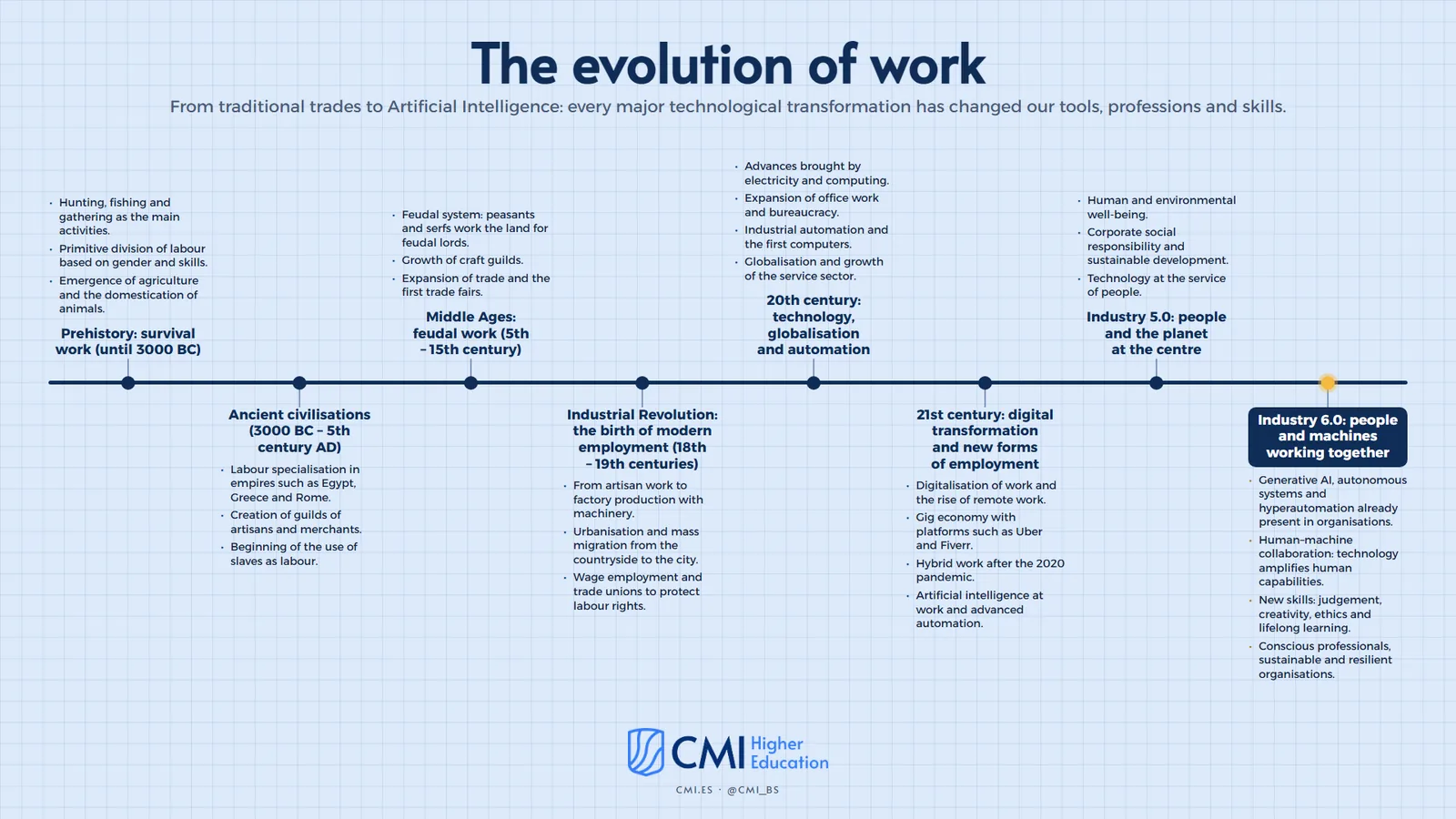
Work has always been bound up with the evolution of society. From traditional trades to automation, the Internet and Artificial Intelligence, every major technological transformation has changed not only our tools, but also the professions, the organisations and the skills we need.
In the first article of this series we looked at that historical journey. Today we face a new transformation driven by Artificial Intelligence, autonomous systems, advanced data analysis and collaboration between people and machines. A profound change we call Industry 6.0.
From mechanisation to connected intelligence
Industrial evolution has passed through a series of key stages to reach the present:
- Industry 1.0: Mechanisation, the steam engine and coal power.
- Industry 2.0: Mass production, the assembly line and electricity.
- Industry 3.0: Electronics, computing and early automation.
- Industry 4.0: Internet, cyber-physical systems, connectivity and digitalisation.
- Industry 5.0: People at the centre, human well-being and sustainable development.
- Industry 6.0: Artificial Intelligence, autonomous systems, hyperautomation, resilience and conscious value creation.
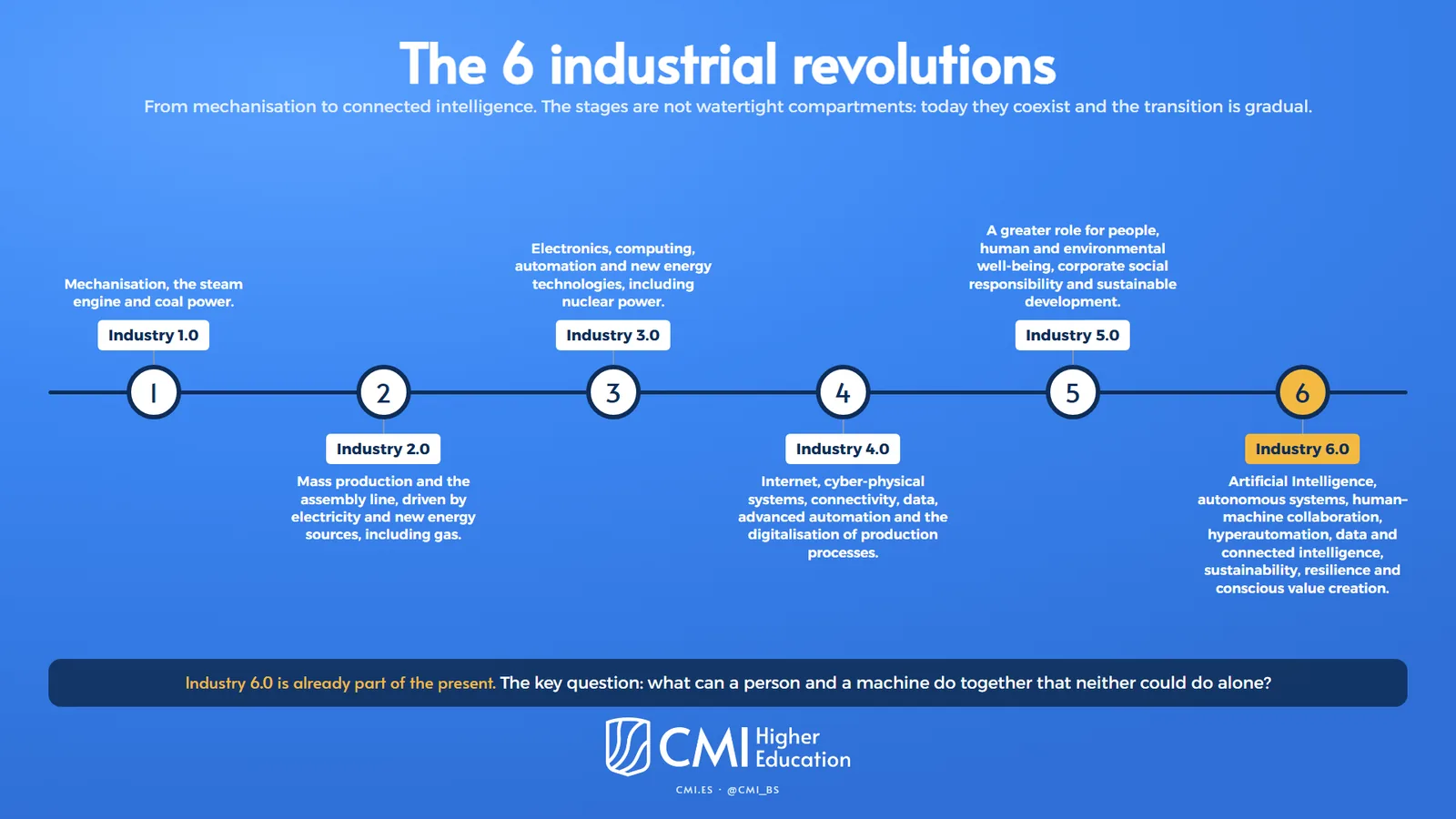
These stages are not watertight compartments; they coexist and overlap gradually within organisations. What really matters is to understand that this transformation is already changing the work we do and the way we do it.
Industry 6.0 is already part of our present
Talking about Industry 6.0 is not gazing at a distant future. Generative AI, autonomous systems and hyperautomation already operate in many professional environments. The debate is no longer about which technologies will arrive, but how we are going to work with them.
The real disruption happens when technology stops being a mere tool and becomes part of decision-making processes. In this scenario a key question arises: What can a person and a machine do together that neither could do alone?
From the professional who uses technology to the professional who works with technology
During digitalisation, the goal was to learn how to use new tools. Today that is no longer enough. A professional must understand the capabilities and limitations of technology, how to integrate it and when to use it.
AI can analyse data at great speed, but organisations still need people able to ask good questions, interpret results, set priorities and take responsibility. Judgement, creativity, empathy and the capacity to decide are what radically set people apart from machines.
The professional of the new environment will not be the one who knows the most technology, but the one who knows how to integrate knowledge, technology and judgement.
New skills for a new reality
The labour market is changing at great speed. The World Economic Forum’s Future of Jobs Report 2025 indicates that close to 39% of today’s professional skills will undergo significant transformation before 2030.
Knowledge is no longer static. People need to keep up to date continuously, combining:
- Analytical thinking and problem-solving.
- Technological competence and an understanding of AI.
- Creativity, innovation and lifelong learning.
- Communication, collaboration and critical thinking.
- An ethical outlook and an understanding of sustainability.
No professional can remain detached from the technology that is transforming their discipline.
Specialisation is no longer enough
Specialisation remains essential — a doctor, a finance professional or an engineer must master their subject — but a new need appears: the ability to connect knowledge.
Artificial Intelligence and sustainability do not belong to a single department; they cut across finance, marketing, education and healthcare. The professional of the future must keep a solid grounding in their discipline while developing a sufficiently broad interdisciplinary vision.
People and machines: collaboration, not replacement
One of the great concerns is the impact of AI on employment. History shows that technologies destroy tasks but generate new activities and opportunities.
Today’s change goes further: it is changing the very composition of jobs. Technology takes on repetitive tasks and data processing, allowing people to devote more time to analysis, strategy, relationships and creativity. The challenge is to design a relationship in which technology amplifies human capabilities.
Technology with ethics, purpose and conscious education
Every innovation must go hand in hand with responsibility. AI raises challenges around privacy, bias, transparency and security, which means adding ethics, judgement and awareness to the technological equation.
This reality also requires transforming higher education. Institutions must move beyond models based solely on the initial acquisition of knowledge and provide the tools to understand, adapt and transform.
At CMI Higher Education, this vision translates into the cross-cutting integration of approaches such as STEAM, technology as a professional enabler, innovation, sustainability and conscious development. Training a professional today does not mean turning them into an engineer, but ensuring they understand the tools redefining their sector and know how to use them with rigour and responsibility.
The work of the future starts today
The evolution of work does not stop. Industry 6.0 is already changing the way organisations operate, and the great challenge is not only to develop advanced technologies, but to ensure that people use them to build a more innovative, sustainable and human environment.
The new economy does not eliminate specialisation; it demands a new key skill: connecting specialisms, people and technologies.