Adrián Sánchez Vázquez / Lecturer at CMI Higher Education
The term “invasive alien species” (IAS), or simply “invasive species”, has become increasingly popular in recent years. But do we really know what they are, and how far they affect biodiversity and sustainability?
What are invasive alien species and what impact do they have?
Although there are several definitions, they can be described as non-native or alien species that have been introduced into an ecosystem through human action (deliberate or accidental) and have managed to establish themselves, reproduce and spread there, with adverse ecological, economic and social consequences (Rendón-Hernández et al., 2024).
Among their ecological impacts, invasive species increase the likelihood of native species becoming extinct: they affect their genetic make-up, change their behaviour and abundance, and disrupt food webs and nutrient cycles, among other effects (Pyšek et al., 2020; Blackburn et al., 2014). These ecological impacts lead in turn to socio-economic ones, with significant losses in sectors such as agriculture, forestry, fishing and tourism (Haubrock et al., 2021).
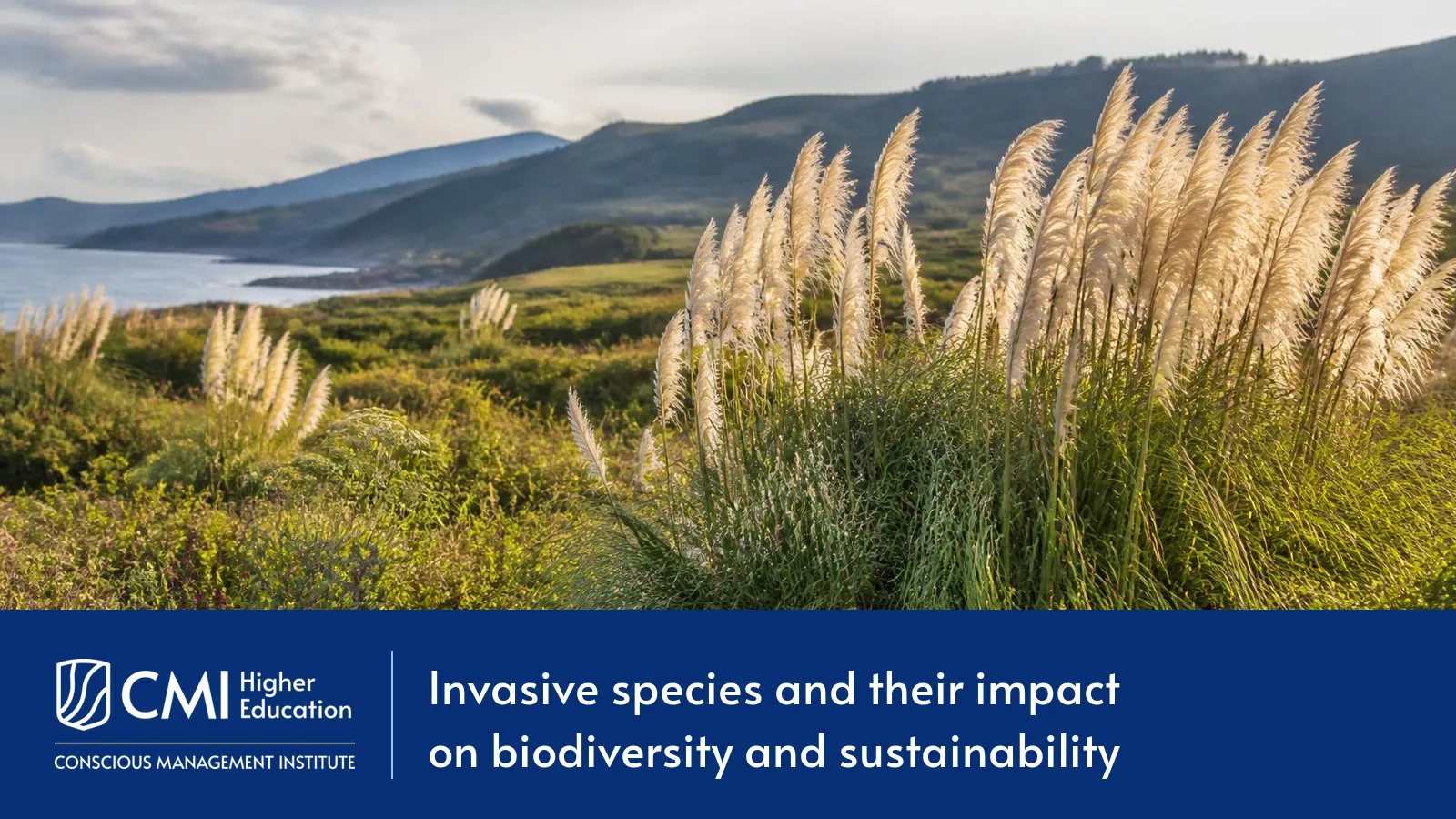
A particularly relevant example in Spain is the plant Cortaderia selloana, commonly known as pampas grass. It is native to subtropical South America (Argentina, Uruguay, Chile…) and today, along the Atlantic Arc, it ranges from southern Portugal to the French region of Nouvelle-Aquitaine, across the whole of northern Spain (LIFE STOP Cortaderia, 2020). Recent research (Fagúndez and Sánchez, 2024; Pardo-Primoy and Fagúndez, 2019) shows that it thrives especially in disturbed environments (roadsides, industrial areas and the like) and is highly able to adjust its growth and resource allocation, which gives it a clear advantage over the native species it competes with.
The current situation of invasive alien species
According to Herrera et al. (2025), invasive species have increased at an unprecedented rate worldwide in recent decades, driven largely by climate change, international trade and human mobility, with serious consequences.
The problem is global: in 2023 there were more than 3,500 invasive alien species with documented impacts, and they had contributed to 60% of recorded plant and animal extinctions. Their economic cost exceeded 423 billion dollars a year in 2019, a figure that has roughly quadrupled every decade since 1970 (IPBES, 2023).
What role do corporate social responsibility and sustainability play?
Invasive species are therefore a major challenge for sustainability and corporate social responsibility (CSR), because companies interact with ecosystems all the time through projects, the upkeep of their facilities, supply chains and resource extraction, among other activities. Poor management in any of these areas can contribute to the introduction or spread of invasive alien species.
From this perspective, the framework of the Taskforce on Nature-related Financial Disclosures (TNFD) proposes identifying, assessing, managing and reporting nature-related dependencies, impacts, risks and opportunities, and invasive alien species are among them (TNFD, 2023).
In short, avoiding business decisions that introduce or spread invasive species broadens the view of sustainability: it takes in not only issues such as resource use and climate change, but also the factors that directly affect how ecosystems function. Science, conservation and corporate responsibility must be the pillars for reducing future environmental impacts, economic costs and social risks.
References
- Blackburn, T. M., Essl, F., Evans, T., Hulme, P. E., Jeschke, J. M., Kühn, I., et al. (2014). A unified classification of alien species based on the magnitude of their environmental impacts. PLoS Biology, 12(5), e1001850. https://doi.org/10.1371/journal.pbio.1001850
- Fagúndez, J., and Sánchez, A. (2024). High variability and multiple trade-offs in reproduction and growth of the invasive grass Cortaderia selloana after cutting. Weed Research, 64(3), 251–260. https://doi.org/10.1111/wre.12631
- Haubrock, P. J., Turbelin, A. J., Cuthbert, R. N., Novoa, A., Taylor, N. G., Angulo, E., et al. (2021). Economic costs of invasive alien species across Europe. NeoBiota, 67, 153–190. https://doi.org/10.3897/neobiota.67.58196
- Herrera, C., Jurado-Rivera, J. A., and Leza, M. (2025). Invasión de Vespa velutina en la isla de Mallorca (Islas Baleares, España): un enfoque multidisciplinar para la gestión de esta especie exótica invasora. Ecosistemas, 34(3), 2939. https://doi.org/10.7818/ECOS.2939
- IPBES (2023). Summary for policymakers of the thematic assessment report on invasive alien species and their control. IPBES Secretariat. https://doi.org/10.5281/zenodo.7430692
- LIFE STOP Cortaderia (2020). Estrategia transnacional de lucha contra Cortaderia selloana en el Arco Atlántico [Transnational strategy against Cortaderia selloana in the Atlantic Arc]. View document (PDF)
- Pardo-Primoy, D., and Fagúndez, J. (2019). Assessment of the distribution and recent spread of the invasive grass Cortaderia selloana in industrial sites in Galicia, NW Spain. Flora, 259, 151465. https://doi.org/10.1016/j.flora.2019.151465
- Pyšek, P., Hulme, P. E., Simberloff, D., Bacher, S., Blackburn, T. M., Carlton, J. T., et al. (2020). Scientists’ warning on invasive alien species. Biological Reviews, 95(6), 1511–1534. https://doi.org/10.1111/brv.12627
- Rendón-Hernández, E., Ayala-Pérez, L. A., Golubov, J., and Torres-Lara, R. (2024). Especies exóticas invasoras y sus implicaciones sobre los bosques de manglar en las reservas de la biosfera Ría Celestún y Ría Lagartos. Madera y Bosques, 30(spe), e3042627. https://doi.org/10.21829/myb.2024.3042627
- Taskforce on Nature-related Financial Disclosures (2023). Recommendations of the Taskforce on Nature-related Financial Disclosures. View publication
About the author
Adrián Sánchez Vázquez lectures at CMI Higher Education in Corporate Social Responsibility (CSR) and Sustainability, and is a biologist specialising in the environment, biodiversity and environmental education. He holds an official Master’s in Environmental Engineering and Management and an official Master’s in Teacher Training (Biology and Geology), and has extensive experience in environmental and sustainability consulting: environmental impact management, biodiversity, environmental assessment and compliance, and the integration of sustainability into business. His main research interests are invasive alien species, environmental impact, biodiversity, environmental management and sustainability. View his profile.