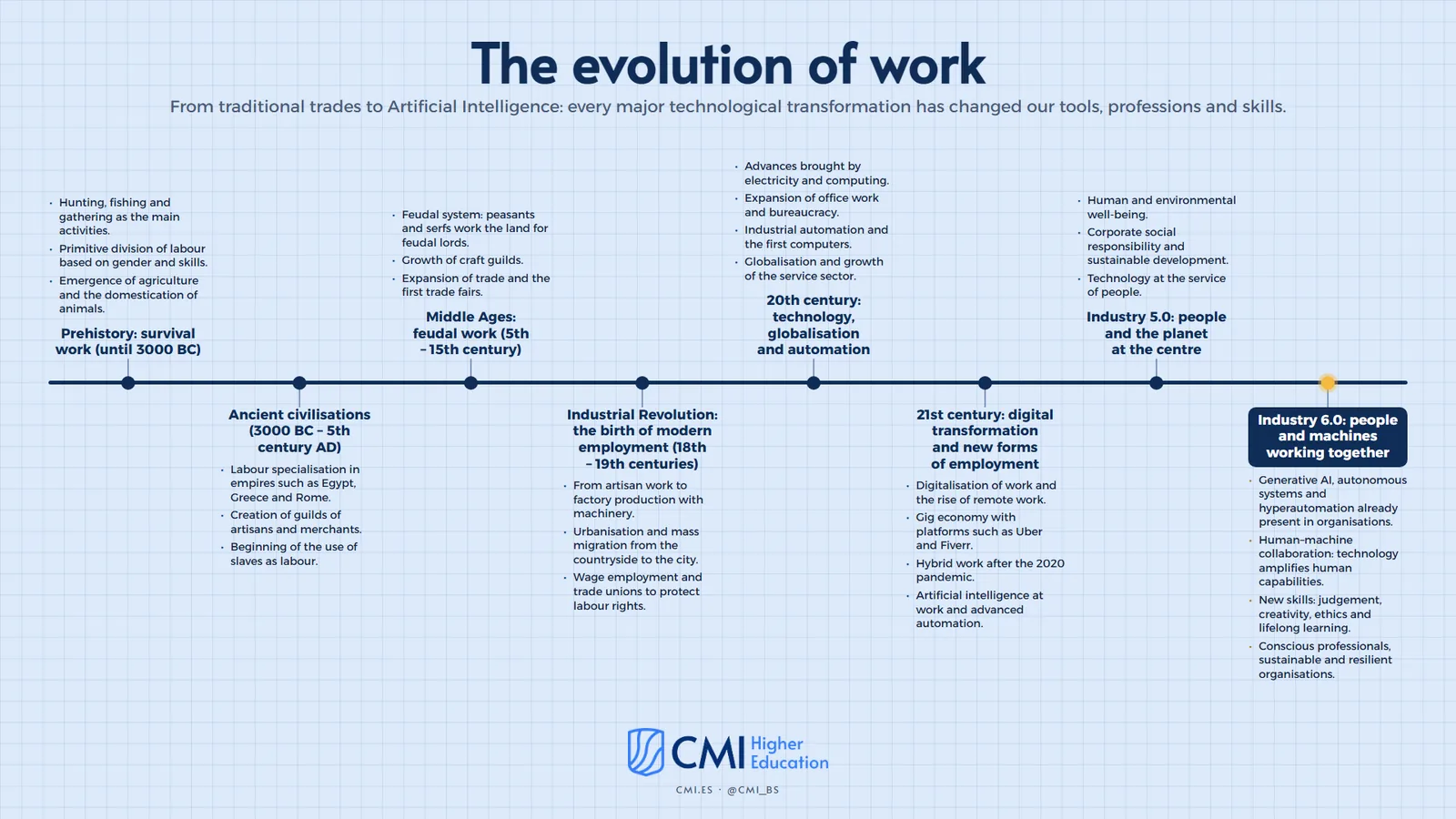
The evolution of work is unquestionably a thread that runs through history, adapting to the social needs and technological tools of each moment. In doing so it shapes, for every era, a particular understanding of what work represents in a person’s life and of how it relates to that life, touching every personal sphere rather than confining itself to a purely “occupational” sense.
Work has evolved alongside humanity itself and alongside technological development. On that point, Maslow’s hierarchy of needs illustrates how we have gone from climbing through its five stages to sheltering almost entirely at its base, putting physiology and safety ahead of everything else.
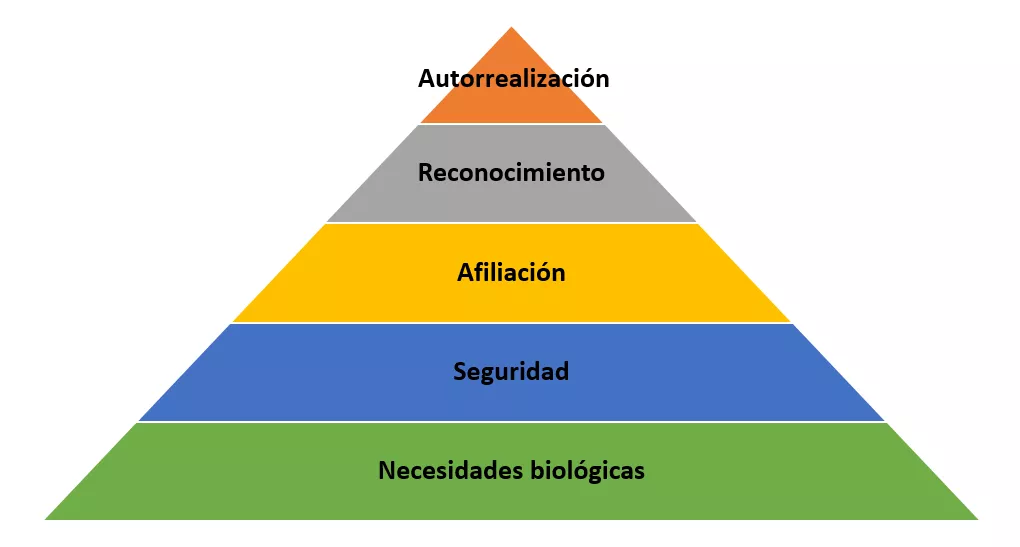
On this point, the course of history has taken us from concepts such as guilds and trades to work as it is understood today, after the Industrial Revolution, and more recently through a process of complete technological change and digitalisation on a global scale that has generated new social needs calling for quick, dynamic answers.
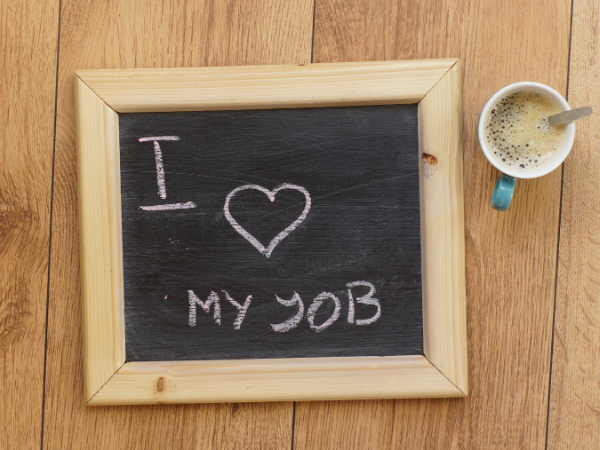
One of the most striking figures comes from research into happiness at work: while in Europe 45% answer in the affirmative, in Spain that falls to a mere 37%. Extrapolating the figures more generally, one might say that more than a third of the Spanish population is unhappy at work — which carries serious negative implications beyond the workplace, affecting people’s health, their social relationships and their psychological and emotional well-being.
Dissatisfaction at work
To some degree what these figures show is that a section of society is distressed by the work it does day after day and which, in a sense, becomes its personal plan for the future and for life itself. That can only have a negative effect, producing people who are unwell and suffering both physically and psychologically: anxiety, stress, burnout, the absence of any work–life balance, a lack of self-recognition. In short, the thwarting of a life plan in which a person’s work forms a positive part, giving it a purpose rather than being reduced to a simple exchange of labour for a salary at the end of the month, in order to subsist in a cycle devoid of meaning.
Reducing these effects requires companies — and therefore people — to reflect on their situation and decide to act by strengthening psychological capital, always with good work in every sense as the leitmotiv. Companies have already begun investing in development programmes designed to build and improve the skills, capabilities and psychological resources that raise levels of well-being and performance among their workers.
Investing in psychological capital thus has a direct effect on the quality of the work done and on the working ecosystem, moving from the individual to the collective and putting in place a corporate culture that reinforces and supports people in their improvement and personal well-being — and, in consequence, supports the organisation in the same terms.
Models in the evolution of work
The evolution of work shows itself through new working models that are gradually taking hold in society.
- Job crafting: personalising and redesigning a role so that it fits the person and their particular qualities more closely.
- Job sharing: a way of relieving the physical and psychological pressure certain roles place on people, by dividing the role and its tasks and having people cooperate on them.
- Gig economy: a form of work characterised by short-term contracts, in which the worker performs a specific function within a project in order to reach the final objective.
- Knowmads: professional profiles whose added value is knowledge, with a considerable capacity to adapt and transform themselves in a dynamic, continually evolving society.
Taken together, these form a basis for understanding and illustrating the new possibilities work offers — possibilities in which, rather than acting as automatons performing a set task in exchange for a salary and with no personal stake in it, a new tendency emerges to make work an element of identity and personal productivity. It means adapting work to our individual characteristics and learning that today’s society, and tomorrow’s, is governed by a dynamism that obliges us (in many cases) to abandon the idea of a single post in a single organisation, doing the same task with the same tools for life until a possible future retirement.
Job crafting and the gig economy are worth singling out as two concepts whose influence will grow over time — all the more so after this fateful period, in which society is going through a stage of adapting to and reinterpreting the world of work, much as is already happening with remote working, however forced the march.
An inward look at work
By way of a closing reflection, and with particular attention to the substantial change society is living through and will experience more intensely within a few months: in the field of human management it is crucial that workers examine their own conscience about their job, so as to work on themselves and improve whatever needs improving — through professional support within their companies and through personal work on self-knowledge and planning. We need to rediscover work as a craft, as something that constitutes our identity, and that serves as purpose and life plan: to make work our own, rather than letting it dominate us and dictate our health and well-being as though it were a penance.
There is also the continuing technological evolution and digitalisation of a globalised world, where constant readjustment is needed if one is not to be left off the board, and where the new tools available to us must be exploited with caution and understanding — otherwise we fall into phenomena such as technostress. Used well, they let us do our work more efficiently, more productively and potentially more safely. That said, this contemporary and future reading of work calls for skills that have to be trained if they are to centre on people, giving greater weight to the human factor than to technology and digitalisation. Otherwise we shall return to automated processes that strip out what people add: creativity, ingenuity, empathy, adaptability and the capacity to learn.
Finally, we must do away with the dichotomy of working to live or living to work. We have to go a step further and understand that it is possible to work and live just as it is to live and work. They are not incompatible concepts but synergistic actions, in keeping with the way we live now.
Jorge Jiménez — Student at CMI