
A world as dynamic and technologically fast-moving as ours demands corresponding change in society and in our ethical thinking — including at work, and in matters such as the curriculum vitae.
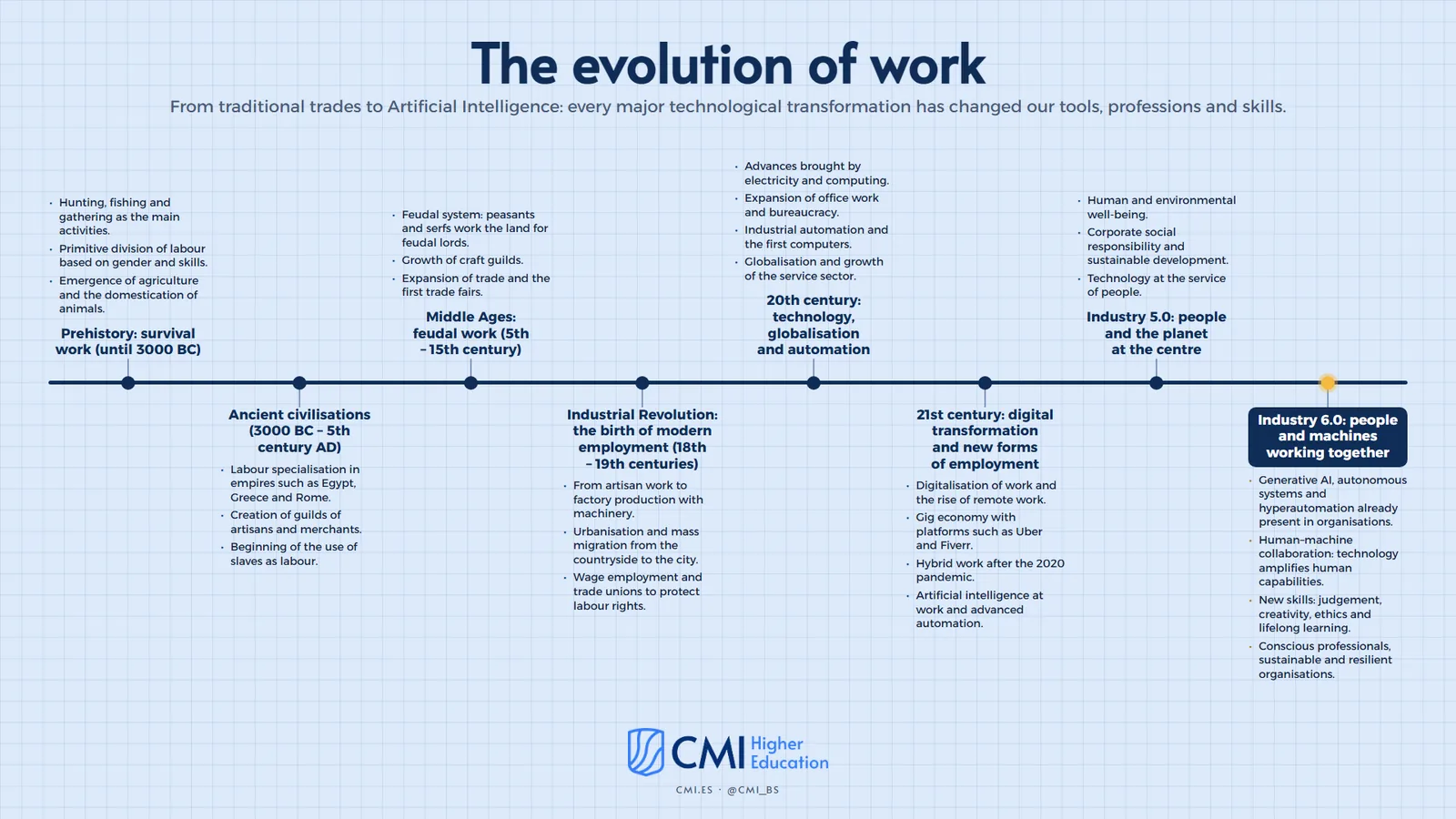
Borrowing the concept of liquid work, after the celebrated sociologist Zygmunt Bauman1, the last two decades have brought a radical change in work and in how society conceives of it, driven by an unprecedented digital revolution.
The development and spread of technologies and devices, with the internet as the cornerstone of them all, has marked a before and after in employment — not only reinterpreting established trades but giving rise to jobs that until now did not exist.2
In this context of liquidity and continuous change in the labour market, it would be logical to expect the relationships and practices within it to adjust to today’s parameters and possibilities. That does appear to be happening, with certain exceptions. And it is here that the paradox of the curriculum vitae arises: a document so deeply rooted in working culture that, despite the inexorable passage of time, it remains unchanged — in most cases at least — as our personal logbook of academic and professional experience and achievement.
A more anthropological view of recruitment
In Darwinian terms we might apply the maxim of adapt or die, though reinterpreted through today’s paradigm as innovate or die — something that looks unavoidable for the CV, or at least for the classical conception of it.
Gradually, recruitment processes are being run by professionals whose training and values are far removed from those that prevailed decades ago, when people were understood as resources or products. What counts now is a more anthropological view, centred on candidates’ aptitudes and potential competencies.
That substantial change should be accompanied by a renewed conception of the CV, incorporating sections such as a LinkedIn profile, a personal website as one’s own brand, digital skills and abilities, and social media.
And yet, whether because of the classical conception of the document or because part of the population resists digital change, a quick Google search still turns up CV templates carrying irrelevant details — some of which may strike people as uncomfortable or trivial. Examples include:
– Binary identification of gender
– A personal photograph
– Information regarded as sensitive (identity card number)
– Age
– Hobbies, and in extreme cases even
– Marital status, number of children, questions of pregnancy, nationality, area of residence
The curriculum vitae: renewal or extinction
Faced with this, the traditional conception of the CV has two paths open to it: renewal or extinction. Evidence of that can be seen in the emergence in various countries of anonymous CVs3 and blind CVs4.
These are characterised by the absence of personal details beyond those strictly necessary and relevant to applying for a job — that is, the individual’s academic and professional experience. The aim is to prevent discrimination in employment on grounds of gender, nationality, age or prejudice.5
It therefore falls to society, and to educational institutions in particular, to teach values both to individuals and to companies, so that classical and obsolete assumptions about who may or may not be given a job — based on traits and characteristics irrelevant to doing it — can be rooted out. The mission is clear enough: to reinterpret the CV so that it serves non-discrimination and the worth of the person. But there is still a long way to go.
Jorge Jiménez, student on the Master in Human Management and Organizational Development at CMI