
Saying that remote working is the future is hardly original any more. What is genuinely new is a virtual May Day, with demonstrations held over the network and followed online. Are the comparative radar images of air traffic before and after new, or the pictures of great cities without pollution and with clear water where there had been filth and diesel? All of this is producing a new paradigm of industrial relations and sustainability.
The pandemic has plainly changed our ordinary lives, not least through lower consumption. But could consuming less push workers into unemployment? Can companies compete in markets without (compulsive) consumption? What will become of the motor industry without vehicle sales? Let us not fool ourselves: the question is not the combustion car or the electric one but the model of consumption and employment. Employment above 85% of the working-age population is supposedly unattainable in almost any economy in the world. So what then? The successful Scandinavian model proposed more investment in training and in work–life balance alongside more employment, less discrimination against women’s work and, above all, proper recognition of work involving social care for our elders and our children.
In that model, inevitably, remote working rises and trade unions fall — or at least are transformed. In others, such as the model proposed by Frédéric Laloux, workers make their companies competitive through taking part in decision-making and through the company’s evolutionary purpose and wholeness; the organisation adapts and evolves in line with the prevailing social model, far less aggressive towards the environment and far more attentive to people.
Restructuring industrial relations
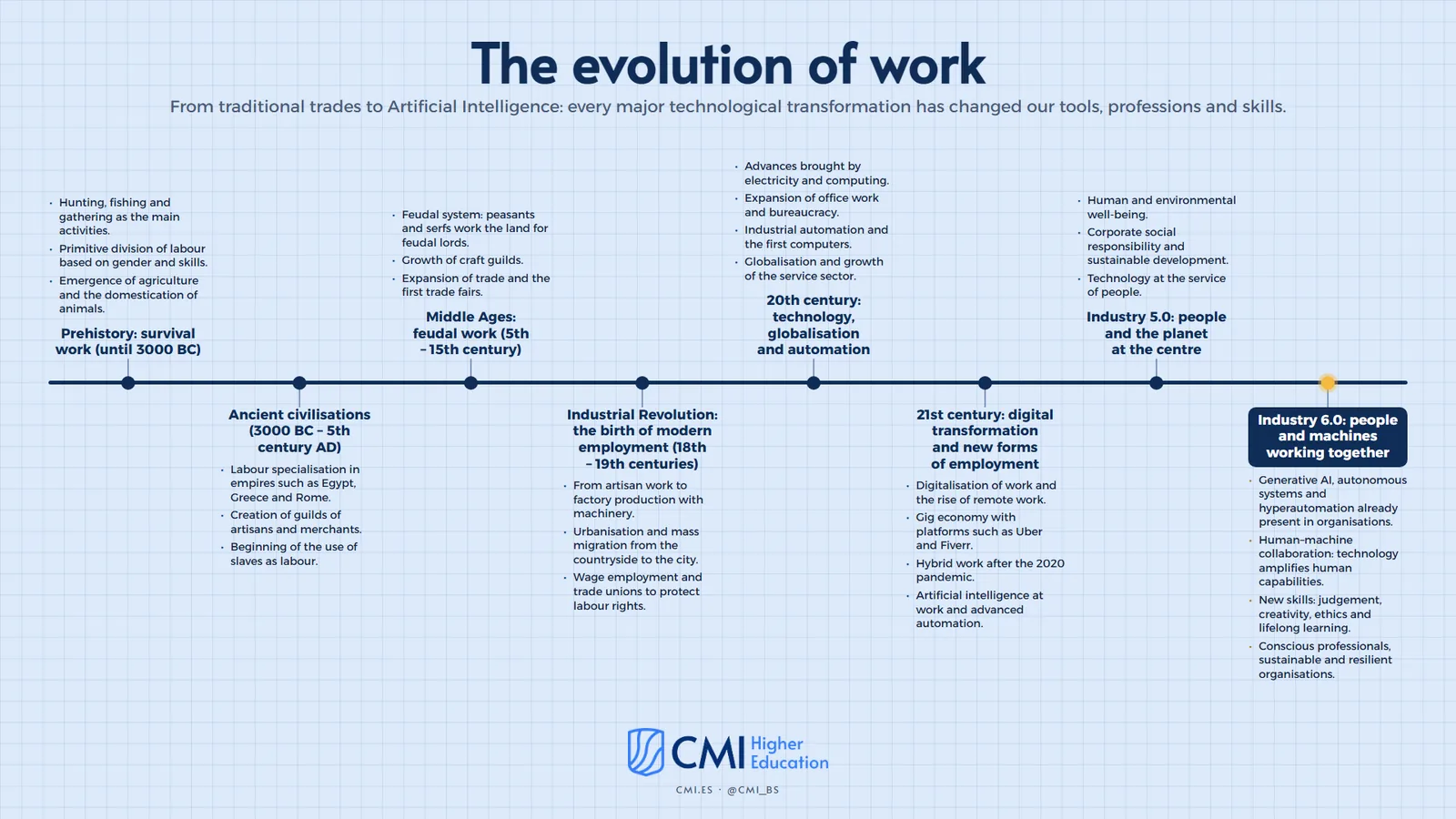
What happens, then, to the classic model of industrial relations? What survives and what disappears? Laloux identifies models of organisation and social paradigms belonging to each historical period: the tribe and prehistory, hierarchy and the post-war years, or objectives and the end of the last century and Wall Street. Each organisational model corresponds to the interests and the yearnings of the society of its day — right up to our own. Today, more than before the pandemic, our social and professional conduct is governed by an awareness of health, solidarity and wholeness. Consumption must be curbed, or at least its degrading effect on the environment and on our capricious appetites avoided.
But what are we to do about the part of that model which bears on our jobs? First, accept that technological advance will spare us the need for everyone to work; which is to say we must think about how to sustain a pension system, a basic income, unemployment benefit and the other institutions of the welfare state. Then, and also as a condition of the system’s sustainability, we shall have to try to maintain a minimum level of production in the sectors that contribute most to GDP: cars, tourism and construction.
To that end we believe a restructuring agreement — rather than a reconstruction one — is vital: an agreement on the framework of consensus and common sense that governed industrial relations in these sectors during Spain’s transition to democracy. Those were the real Moncloa Pacts, built on collective agreements and framework agreements which, while safeguarding each side’s interests, guided action towards a shared objective: the survival of the company, the sustainability of organisations. All of this is required in the new paradigm of industrial relations and sustainability.
What such an agreement should aim at
Let us look at some of those objectives:
- Employment through cost: before redundancies, cuts to salaries and other substantial changes, subject to the limits of health and safety. In all probability the number of working days and their length will have to be reduced; overtime, certainly, should be banned. In general, more time devoted to personal life and less to working life. Nor does the measure contradict the objective on cost — the Nordic countries have been doing it for years.
- Decisions taken as jointly as possible on production, quality or logistics, bringing workers closer to the management process and giving weight to their real experience and knowledge, while integrating and motivating them by valuing what they contribute. The change means rebalancing the framework of social actors, away from the present supremacy of shareholders and towards employees, their families, consumers and customers.
- Redefining the tax framework and the purposes of taxation. The problem is not the deficit but its cause. Contributions will have to rise, and with them the taxes levied on earnings from work but also on consumption. It seems to have been forgotten that consumption is, in itself, selfish and lacking in solidarity. As far as industrial relations are concerned, we cannot go on trying to subsidise hiring: what should be subsidised is better training. We might therefore consider rewarding organisations that reach agreements on employment, working hours and changes to how decisions are made.
- Hence the great matter to be resolved is collective bargaining. The key to the change of paradigm will lie in the slant we choose to give this institution: in our recent history the defining feature has been imbalance in favour of one side or the other. Can we envisage a framework of balance? First, set a time limit on negotiations to head off delaying tactics. Then the scope — temporal, personal and geographical. Can we consider a broader scope, covering a large number of organisations at once? It may require revisiting the concept of representativeness, or even of democratic legitimacy, but it is perfectly feasible for agreements to cover large groups and be negotiated by less direct, more sector-wide representatives. Finally, the imbalance between companies in the same sector: we ought to widen, if only slightly, the scope of the “legal minimum”, narrow the room for bargaining over particular demands and “gains”, and in short reduce the scope of the parties’ autonomy — which does not mean limiting rights but redistributing conditions. What has been done so far on occupational risk would be an example.
There are many more points within the paradigm in need of reform. Pensions, the retirement age (is it serious to go on granting early retirement at 52? is it serious to contemplate doing so at 72?) — though there is no point in an endless panegyric either. Just one more: the necessary renewal of the foundations and the profiles of trade unions. Their activity needs reinventing (though not their reason for existing) and, above all, their leaders need professionalising — probably in greater numbers at senior level and fewer at the basic, company level.
In summary, the new paradigm of industrial relations suggests an approach aligned with the measures of social responsibility and sustainability we all now believe need putting in place: one that transforms the model of industrial relations towards a balance that cuts across society, without so much trench warfare of class or representation; that is flexible where flexibility works but keeps solidarity and the common good as its compass; universalist in its respect for human rights, global, and open to innovation. And sustainable, besides.
Emilio Marcos — Lecturer at CMI