Until very recently, ethics applied to companies and organisations tended to concentrate on matters directly tied to the management model. The key question business ethics usually faced was: how do we respond to stakeholder expectations? That question led directly to managing the impacts an organisation’s activity generated on those stakeholder groups. In this article we look at what the purpose of business ethics actually is.
Seen this way, one often heard that ethics was fundamentally about the how. That pushed organisations wishing to bring ethics into their management towards developing codes of ethics and codes of conduct — in short, towards ethical tools that would help build a corporate culture in which ethical values played a significant part.
It is true that this approach alone has produced a great deal of progress. By way of example, one might cite the following:
- The adoption of a stakeholder-based approach to management.
- The prominence of ethical intangibles as the outcome of managing an organisation ethically.
- The development of new indicators capturing a company’s performance from a broader perspective than financial results alone.
Ethics within the company
On that basis, one could argue that a company whose mission is to develop products or services connected with activities that much of the population finds objectionable — however legal they may be — could still be an ethical company. That is, it could have a management culture in which ethics was perfectly well integrated.
Important as that is, a significant step forward now appears to have been taken. It comes principally through the idea of purpose which is, beyond any doubt, one of the fashions of the moment.
But what does it mean to talk about purpose from the standpoint of business ethics?
In the first place, it means putting back on the table — with a prominence that had visibly diminished over recent decades — the fact that a company is a social institution. A company is part of society. It may seem obvious, but looking back one can see that for several decades this was not much in evidence.
If a company is part of society, as the social institution it is, then in order to be legitimate in carrying out its activity it must contribute something positive to society as a whole.
What a company is for
That is precisely the driving idea behind introducing purpose into a new way of defining what we want companies to exist for.
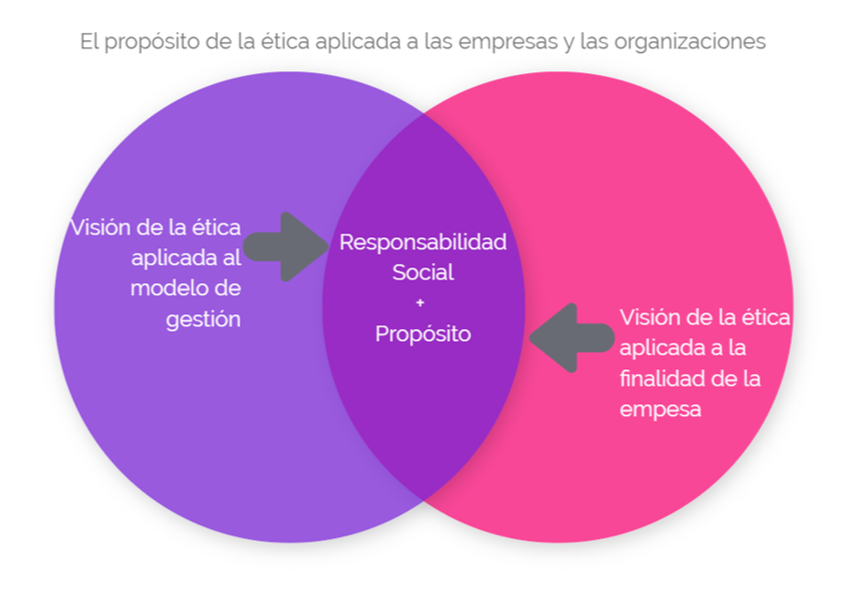
We are therefore no longer talking only about how a company is managed. With the idea of purpose we are asking what the company contributes: what a company exists for, what its ultimate end is.
The idea of purpose is thus decisive from an ethical standpoint, because the focus is no longer only on how an organisation is run. Ethics now brings its full weight to bear on defining what the company is for.
This does open up a discussion, or at least a reflection, on which purposes strike us as worthwhile. On that question the Sustainable Development Goals of the United Nations 2030 Agenda offer a good guide. They are broad enough, demanding enough and beneficial enough to the planet that there is little need to go looking for or inventing other purposes.
Roberto Ballester
Partner at Felidarity
Lecturer at CMI