In this interview, the expert on technological transformation explains what digitalisation systems are, the key questions we should ask ourselves before putting any of it in place, and what they offer companies — whatever their size — particularly at times of great change and digital advance such as 2020.
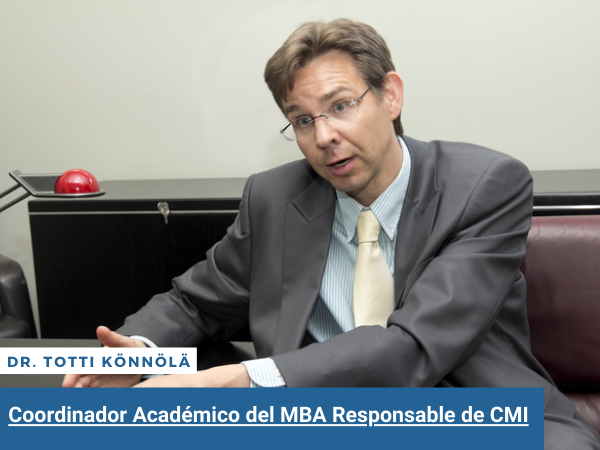
Totti Könnölä holds a PhD in Technological Sciences and a Master’s in Environmental Economics. He is a director and adviser in the fields of innovation, entrepreneurship and digitalisation, and the founder and CEO of two consultancies — formerly Impetu Solutions and now the Insight Foresight Institute. He is a passionate advocate of technological and social transformation.
He describes himself as a “hybrid” professional, having coordinated numerous foresight, evaluation and decision-making projects with industrial managers, research directors, policymakers and other interested parties. Hybrid, too, because his roles as director, adviser and expert come together to bring all that store of knowledge, experience and tools to his students: he is also academic coordinator of CMI’s Responsible MBA and a lecturer on the master’s programmes in CSR and Sustainability, Responsible Marketing and International Trade Management, Human Management and Organizational Development, and Sustainable Finance Management.
His module “Managing digital information and communication systems in organisations”, in which he covers in depth the subjects he introduces here, was in fact the most highly rated by MBA students for its content, its practical application and its teaching approach.
Eager to read what this expert has to say for your company, organisation or project? Read on.
- What are digital information and communication systems in companies? Why did so many of them start putting these in place this year?
This year has been brutal for a great many people. With the pandemic, companies have had to digitalise, in very little time, things they could never have imagined. That has had an effect over the long term as well: it makes us think about how we are going to manage our information and communication from here on.
A company’s information systems are hard to change from one day to the next, so what they had to do was get the most out of the tools closest to hand. What matters fundamentally is thinking about how information is used, and how we can use it to connect suppliers, colleagues and partners, and so understand what is happening around us and be able to act on it.
And that is where we also gather information in order to act in the field of corporate social responsibility — social data, environmental data and economic data alike.
With these advances, companies are now looking at the advantages remote working can bring, or work split across different continents and offices. They also create new challenges around how to establish those working relationships and find new solutions.
- When we talk about digitalisation systems, are we always talking about large companies, or is it something small ones can do too?
I do not think it has to be something only for large companies. Really, any company today tends to have at least email. And with the cloud we also see a great many opportunities to take out subscriptions to different systems that can then be integrated.
Having your suppliers and information solutions in the cloud lets you scale a business up, or reduce the load. This integration of platforms gives us greater flexibility, the ability to scale to different levels of complexity, and answers to some of the questions about how we guarantee security and make sure everything is up to date. Those are some of the benefits of having a provider manage the cloud.
What can be difficult for a company trying to connect different providers is integrating the information, because in the end what information systems are trying to do is find synergies and give us an analysis of how different functions bear on the business. This is valuable information we shall have at our disposal for managing and developing our company’s strategies.
Small companies can have everything with a single server or provider and be sure there is integration, but there can be problems there too — being tied to that provider, and, if something goes wrong, finding it harder to resolve if it goes beyond what the provider can or will do. What is more, solutions from different providers are often taken on as needs arise, and then comes the problem of how to integrate it all.
But yes, small companies today have every kind of system within reach: customer relationship management, supply chain control, examining their own processes such as accounting. Accounting too is increasingly digitalised; there are systems that help us connect directly with public services and handle all the paperwork more easily.
It is worth looking hard at the opportunities and at how we can reduce costs. And since we now have processes that run remotely, these systems help us whatever the size of the company.
- What are the first steps towards making all this real in a company?
Whenever we talk about buying IT solutions, cloud-based or otherwise, what we have to be clear about is what they are for — which business processes we are going to digitalise. If we are not clear about the strategy, or we do not involve the people who will be using it, it is no use.
If we are going to have a customer relationship management system, for instance, you can involve the sales managers, who know the processes, and the customers’ interests and needs, along with a great deal of other relevant information. In other words, we have to look at the different options and involve the team that will have to carry them out. I think any healthy process can start from there.
- What would you say to someone who is not convinced these processes are worth investing in? Or who runs a small organisation from a single site and therefore thinks it unnecessary?
Well, having everything digitalised is obviously not the final objective. There may be cases where it does not play so important a part.
What is very good indeed is having a conversation with the team and seeing what they need, and thinking about which activity takes up most of our time. That is where we shall see which processes are the ones to digitalise.
In shops with a considerable number of customers, for example, a CRM (customer relationship management system) can help us understand what sells best, identify which customers are the most profitable, work out how to build a relationship with them, connect the data, see what interests them, and much else besides.
If we are running various initiatives it is very easy to lose track of each one and to evaluate whether they have worked. But if we have a communication system connecting the different threads, that not only makes life easier, it helps us find the sense in things, the trends in each sector or the logic by which they work — and that way mistakes can be avoided.
Another important point is that customers increasingly take account of more than what they can see and touch. They want to know where products come from and what raw materials they are made of; they want to know their traceability. So if you have a connected system you will know where the products come from, which links in the chain are involved, and whether your suppliers are responsible — which is a very important asset today — and you will be able to publish all of it.
Digitalisation depends a great deal on the type of business and on the objectives we have. Each case needs analysing to see what is required and what the goals are. But what we do know is that acting on this brings greater organisation, less wasted time, and the analysis and connection of data for developing the business responsibly.