
Responsible communication campaigns: a first look
As users we are subjected to ever more prompting from companies trying to convince us their brands are the best in their field, and so to turn us into loyal customers and conversion targets. The same happens with public and private bodies and with companies of a markedly social character. Responsible communication campaigns have become brands’ great allies in making known the responsible actions and social commitments of these organisations and companies. Over the course of this article, then, we shall look at six successful responsible communication campaigns from 2019.
As Pineda-Martínez and Ruiz-Mora (2019) acknowledge, organisations face a new challenge here. They have to reach an audience that is ever more exposed, given the sheer quantities of information and multi-platform consumption habits. Companies today also seek to project themselves beyond their economic dimensions: in their relationships with people, with stakeholders and with the world (Miño and Cortés, 2018).
Effective communication
Staying with the same authors’ research, we should not forget that communication centred on information falls short in the complex world around us, where practices permanently define, transform and rebuild the social fabric. Hence the growing commitment to human, interpersonal communication.
Technological change and transformation also have a considerable effect on how corporate social responsibility policies are implemented in organisations (Bajo and Villagra, 2010). To this complex business of communicating effectively is added a significant change in the relationship between organisations and stakeholders. So much so that companies have to adapt their content both to stakeholder groups and to formats. It is not a matter of a website carrying numerous links to various policies, reports or codes and considering its communication thereby exhaustive (Castillo and Villagra, 2019).
Starting points
What responsible communication activity should we carry out in order to meet our objectives? How do we convey our social work to our stakeholders through communication? Will the communication campaigns we run be successful? These are some of the questions companies ask themselves, and some of the doubts that arise, when they decide to run responsible communication campaigns.
Answering those questions, and getting the answers right, is a considerable headache for companies, organisations and brands. Added to it is the reality that the average consumer is far more demanding and expects to be treated personally — that is, wants brands to address them directly and individually (Benavides, 2010).
Nor can we ignore the reality of the media. As Baranda (2015) acknowledges, thousands of stories reach news outlets every day. With neither the time nor the means, they cannot all be carried. It is at this point that the media construct the reality shown to us day after day, and what makes one outlet different from another.
With this new situation, in which the media receive far more information than they can publish, companies now concern themselves not only with the purely economic and financial sphere, but with the multiplication of resonant brands and with a shift from a reactive to a proactive attitude among stakeholders. The effectiveness of responsible communication campaigns becomes a critical question for an organisation’s success or failure.
What are responsible communication campaigns?
In identifying six successful responsible communication campaigns produced or run in 2019, we shall take into account that they meet at least one of the following criteria:
1. Online and offline communication campaigns.
2. External and internal communication campaigns.
3. Public relations activity.
4. Communication campaigns conveying values that are positive for society.
5. Communication campaigns seeking to make known products that are socially responsible and committed to society.
6. The organisation of social events.
Here, then, are six successful responsible communication campaigns from 2019:
1. Protos: “Brindis solidario”
This initiative by the Protos winery consists in making a donation to organisations working selflessly to improve society. The company’s CSR activity has a considerable presence on social media: it is the followers of the winery’s Facebook page who decide which organisations the funds go to, and the process ends with a cheque presented at a public event.
The campaign won the 2019 Social Enterprise award in the “Best social media campaign” category from the Fundación Mundo Ciudad.
2. “Hay que estar cerca para verlo todo”, by Cáritas

During 2019 Cáritas launched “Hay que estar cerca para verlo todo” (“You have to be close to see it all”), with the aim of raising public awareness of the problems affecting people living in developing countries. Through that awareness the charity sought to increase regular donations so it could carry on its work in the field.
The agency beon Worldwide devised three images for Cáritas resembling tourist posters for Brazil, Ethiopia and Thailand. Each image was made up of pixels which were in fact small pictures of each of the things Cáritas does in that particular country.
3. #SumaTuLuz, by the Abertis Foundation
The Abertis Foundation’s #SumaTuLuz campaign sets out to make young people aware of the risk of driving under the influence of alcohol and drugs — and does so during their leisure time, in nightclubs.
The campaign’s first action was called “El apagón” (“The blackout”) and consisted in switching off the lights in several nightclubs around the country in order to project video testimony from someone serving a prison sentence for having taken a life while driving under the influence of alcohol.
Although the campaign was first launched before 2019, its activity continued through that year.
4. The scooter company Lime with Mensajeros de la Paz
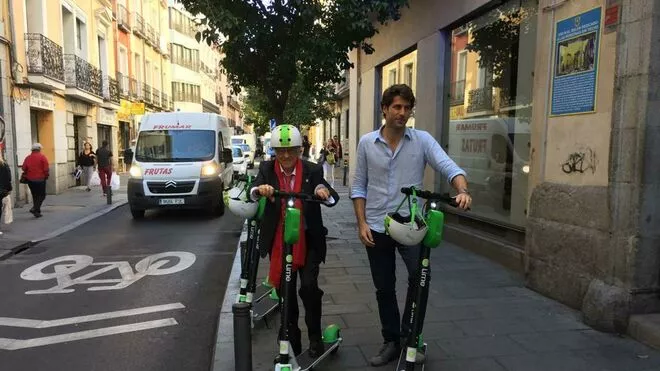
A responsible communication campaign made known the agreement reached between the electric scooter company Lime and Father Ángel’s charity Mensajeros de la Paz. Under it, people at risk of social exclusion would receive training, both theoretical and practical, in charging the scooters and placing them responsibly around the city. Once trained, they could carry out that work for Lime in return for payment.
Besides helping people at risk of social exclusion, Lime also sought to position itself as a socially responsible company concerned with accessibility in cities.
One of the campaign’s most significant actions was the presentation to the media at Father Ángel’s church in Vallecas, which drew a considerable number of outlets and journalists interested in the initiative.
5. #EllasConducen, by Midas
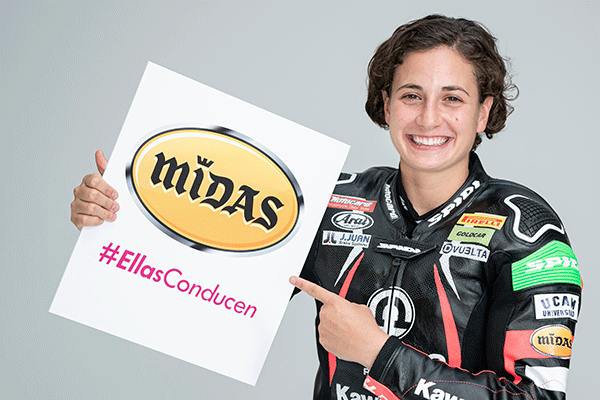
Midas launched the #EllasConducen campaign to break down the myth that women are bad drivers. The company also wanted to strengthen its recognition as a socially responsible organisation.
For the campaign it sought the collaboration of other bodies, including Spain’s Directorate-General for Traffic, the charity Ayuda en Acción and the National Confederation of Driving Schools. Ana Carrasco — the first woman to win a Motorcycling World Championship, in the Supersport 300 category — was chosen as the campaign’s ambassador.
To demonstrate its social commitment, the company undertook to fund a driving licence for a woman at risk of social vulnerability for every 1,000 tweets using the hashtag #EllasConducen, so as to help them gain independence.
The campaign was a 360-degree effort, taking in public relations, design, content creation and digital marketing.
6. “Un final feliz para la hepatitis C”, fronted by a well-known figure

With “Un final feliz para la hepatitis C” (“A happy ending for hepatitis C”), fronted by the actor Carmelo Gómez, the Alliance for the Elimination of Viral Hepatitis (AEHVE) set out to make known that people who have hepatitis C and are aware of it can be cured.
The campaign was conceived for distribution as a cinema advert, and the creative agency also produced a making of for other kinds of screening. The advert shared Carmelo Gómez’s own story.
Conclusions
Having examined these six successful responsible communication campaigns from 2019, the following stands out: organisations find it ever harder to reach end users, in a landscape where messages have multiplied, where more and more newsworthy activity is generated and where the number of organisations keeps growing.
We therefore see organisations becoming more socially responsible and, through corporate social responsibility, engaging more closely with their stakeholders — internal and external alike — in order to lessen whatever negative impact their activity might have.
This social activity is becoming more important, and companies increasingly think about it strategically and as part of the organisation’s structure. The communication dimension matters a great deal here.
Responsible communication, and responsible communication campaigns, have taken on an increasingly prominent role. They are no longer the preserve of social organisations or enterprises: today most organisations have built responsible communication into their strategic plans, aligned with the organisation’s mission and vision in a firm commitment from senior management.
Which raises an important question for debate: will we be able to spot the companies that are not socially responsible but have built responsible communication campaigns into their structure as a commercial lever and a way of laundering their image?
José Manuel Martín — Lecturer at CMI