
Spain’s commitment to research and development (R&D) is out of step with the country’s level of economic development. That is the conclusion reached by a number of reports and rankings, both domestic and international. Government support is thin, but there is a great deal that civil society can do.
Research and development in Spain lags behind the rest of Europe. According to the Cotec Report, published in 2018 by the Cotec Foundation, investment in R&D is below the European average. The report notes:
“that R&D has not kept pace with our country’s economic growth (…) the increase in investment remains — for the sixth year running — below the growth of GDP. Which once again puts distance between us and the countries around us and the European Union as a whole”.
The R&D figures
The most recent study by Bloomberg, which ranks countries on research and development, points the same way: Spain sits in 29th place. Among the variables taken into account are spending on R&D and the density of publicly listed high-tech companies.
The Organisation for Economic Co-operation and Development (OECD) agrees with that reading: relative to its GDP, Spain is today one of the developed countries offering the least public support to science, technology and innovation in the private sector (it ranks 22nd among OECD countries).
It is worth remembering that the shortfall in private investment in research and development is also — and above all — a challenge for public policy, since it falls to government to create the right conditions (regulatory, fiscal, educational, financial, cultural and so on) for a business community that commits in earnest to R&D.
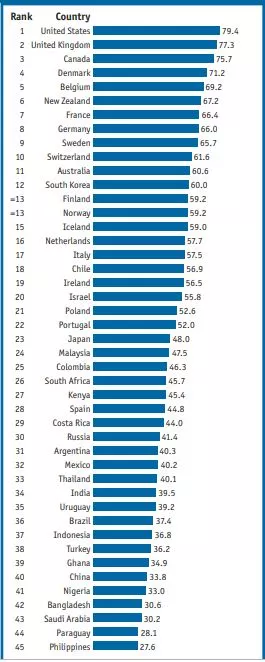
A study by The Economist entitled “Old problems, new solutions: Measuring the capacity for social innovation across the world” likewise places Spain 28th on a list of 45 countries. The research finds that although there are numerous examples of local innovation at municipal level and many initiatives backed by the EU, there is very little national awareness of innovation as a coherent concept, and no national strategy or funding to encourage its adoption.
What can we do?
Beyond the absence of policy, the work that needs doing appears to be fostering a culture of innovation in the country — so that the pressure on the state, and in turn on the private sector, comes from society itself. There is still some way to go on that front, but the seed is beginning to germinate.
Whether from academia, NGOs, private companies or the initiatives of civil society, each of us can do our bit to keep research and development moving forward: through education, through entrepreneurship and, indeed, through corporate social responsibility.
Let us hope that Spain will soon climb the European rankings, giving a lift to creativity and, with it, to the economy and to society.
Further reading:
The Responsible MBA takes third place in the Mundo Posgrado ranking