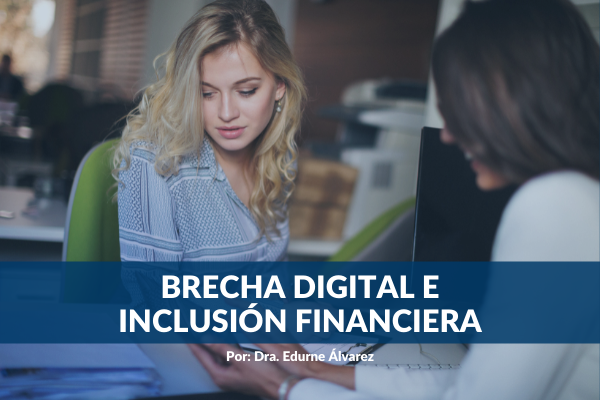
The world faces a severe digital divide (identified in 9 of the SDGs by the UN and made worse by the pandemic) alongside limited access to financial literacy, payment methods and financial services. In low- and middle-income countries, financial exclusion (financial inclusion is an enabler of 7 of the 17 Sustainable Development Goals) is a reality that makes it enormously hard for many people to climb out of the spiral of poverty, when they can barely reach savings products or insurance. It also does great damage to the formal economy: many entrepreneurs who have grown outside the financial system find that although they have managed to build profitable businesses and employ people, they lack even the minimal financial record that would prove it, let them access credit, or bring their workers into the social security system.
In developed countries, where the population keeps getting older, financial exclusion often brings to mind the people badly affected by the closure of the branches that let them manage their accounts, and who find themselves shut out because they do not use digital tools. Answering that challenge is a priority in countries such as Spain, but it is not the subject of this post.
What concerns us today is financial inclusion in low- and middle-income countries, and here digitalisation can become a great ally, letting us tackle the digital and the financial divide together. Almost half the planet’s inhabitants — some 3.6 billion people — do not even have access to the internet, as the International Telecommunication Union (ITU), the United Nations specialised agency, warned at the end of 2019. The digital divide affects 52% of the world’s women and 42% of its men, with a marked geographical inequality: in Africa only 39.3% of people live connected, against 87.2% of Europeans and 94.6% of North Americans (figures from the Internet World Stats portal, May 2020).
According to International Monetary Fund data, close to 1.7 billion adults worldwide are still unbanked. In Latin America, on average, only 45.8% of people over 15 have access to the financial system (ECLAC). The World Bank estimates that around 200 million small and medium-sized enterprises are shut out of basic financial services and credit.
Today more than 50% of people in developing countries have a mobile phone, while only one in four has a current account. Smartphone penetration was expected to be much the same in Latin America as in Europe by 2020, and to reach around 60% in Africa, the region furthest behind.
Against that background, the G20 committed at the 2010 Seoul Summit to promoting financial inclusion worldwide and reaffirmed its commitment to applying the High-Level Principles for Digital Financial Inclusion. Since then, more than 55 countries have committed to advancing financial inclusion, and more than 30 of them have launched or are preparing a national strategy on it. Research by the World Bank Group indicates that reforms move faster and go further where a country applies a national financial inclusion strategy.
The digital divide is a form of poverty and social exclusion, depriving part of the population of resources essential to developing themselves and generating wealth. It produces isolation, in rural areas and in cities alike; it is a barrier to study and to knowledge; it sharpens social differences; and it harms women more than men. When we speak of the digital divide, we should bear in mind that it is not only about access to technology but about the digital skills needed to use it. On that point, and by way of example, the ITU notes that in 40 countries more than half the population cannot attach a file to an email.
It is worth adding here that a smartphone can now cost between $20 and $30, which opens access to every part of the population. But for it to be of use, connectivity in some parts of the world has to improve and people’s digital literacy has to grow. Promoting financial inclusion by this route is a very interesting way of speeding the process along. A mobile transaction account opens access not only to money and credit, but also to public provision and to a range of services such as water, transport, health and education.
Financial inclusion helps increase people’s earning potential; it contributes to their capacity to meet basic needs such as education and health; and it helps them save for retirement or for the unexpected. Better financial literacy also makes people less vulnerable to over-indebtedness and to being cheated. For that to happen, though, financial instruments must be developed that match the needs of people on low incomes.
I cannot end this post without saying a brief word about M-Pesa. In 2007, more than half the population of Kenya had access to a mobile phone. Vodafone launched M-Pesa, a project to turn the phone into a means of payment, which as it developed also opened the way to health and crop insurance and to credit. Its contribution to Kenyan GDP was 6.5% in 2018, and it employed more than 170,000 people, a third of them women. It is estimated that more than 2% of the country’s households have moved out of poverty thanks to access to the service and the financial inclusion it brings. Among households headed by a woman, that proportion doubles.
Through solid relationships with the main money transfer operators — Western Union, MoneyGram, WorldRemit, Remitly and MFS Africa — M-Pesa is also the destination of more than $1.5 billion in remittances each year, including 60% of formal remittances to Kenya and 20% of those to Tanzania. Some reports show how fintech firms and their mobile applications cut the cost of sending remittances by 50%. International remittances contribute to 12 of the UN’s 17 Sustainable Development Goals; in particular, a 10% rise in remittances per capita has been shown to lead to a 3.5% reduction in poverty (United Nations, 2020).
By Dr Edurne Álvarez de Mon González, professor of social and digital innovation at CMI.