It helps to understand what Lean Startup and co-creation are before working out how they affect CSR. When we talk about corporate social responsibility, we do so from the standpoint that it is a way of running companies based on managing the impacts their activity has on customers, employees, shareholders, local communities, the environment and society at large.
CSR has become a dominant concept in business. Every corporation has a CSR policy and produces an annual report setting out what it has done. There is, however, no agreed definition of CSR, which raises the question of what exactly counts as corporate social responsibility. The European Union (2002) defines it as follows:
“…CSR is a concept whereby companies integrate social and environmental concerns in their business operations and in their interaction with their stakeholders on a voluntary basis.”
Embedding CSR
There may be some uncertainty about what CSR is and everything it entails, but most writers are clear that three basic principles together encompass the whole of CSR activity: sustainability, accountability and transparency.
It is likewise essential to connect CSR with sustainable development, which must “meet the needs of the present without compromising future generations”, as the Brundtland Report defines it (1987).
It is not the purpose of this article to enter into disquisitions on the “correct” definition of CSR and what it implies. It is introduced as a starting point, as is the concept of sustainable development, in order to examine what it means for the running of a company itself.
The central idea, then, is the way in which the organisation — understood as the whole body of its members — and the actors it works with should work “voluntarily” to build relationships with customers, employees, other companies, society. In short, with its surroundings.
It is therefore necessary to understand how those surroundings can contribute to developing an organisation’s CSR. To paraphrase John F. Kennedy: “Ask not what your country can do for you; ask what you can do for your country.” That is to say, we shall not be looking at what activities need developing in order to establish the moral and ethical obligation companies ought to have in their relationships. On the contrary, we shall be examining how customers — internal as well as external — not only can but should be involved in the company’s processes. What can we do to put in place a collaborative strategy between an organisation and its surroundings?
To answer that question, two things are proposed: the Lean Startup methodology, applied to developing businesses and products; and co-creation, as a business strategy that leads to joint activity between a company and its customers.
Co-creation and Lean Startup
Co-creation is a word that has become fashionable in recent years and which is set to play a considerable part. In the European Union’s next research and development framework programme, Horizon Europe[1], co-creation methods and approaches are being trialled across its various calls.
Co-creation can be defined as the collaborative development of new value — concepts, solutions, products and services — together with interested parties such as customers and suppliers. It is a form of collaborative innovation: ideas are shared and improved together. Most companies hesitate to share ideas and strategies, but through co-creation it is possible to develop new products, new companies and solutions to problems, all of it through collaboration between the organisation and the various actors it works with.
Co-creation is a business strategy in which we want the various actors a company interacts with to take part in the process. To do that they need to rest on a methodology, and this is where Lean Startup comes in. Developed by Eric Ries (2011), it is a methodology that helps develop products or services in close contact with customers — which is precisely where it fits with co-creation. Its aim is constant innovation and continuous improvement.
The objective is to reduce the risk of launching new products and services. Learning from the customer (customer development) is the key, and the faster and cheaper the better. The Lean Startup philosophy rests on three pillars: validated learning; iteration; and experimentation and innovation accounting. It puts these into practice through the build–measure–learn cycle (Ries, 2008), as shown in figure 1.
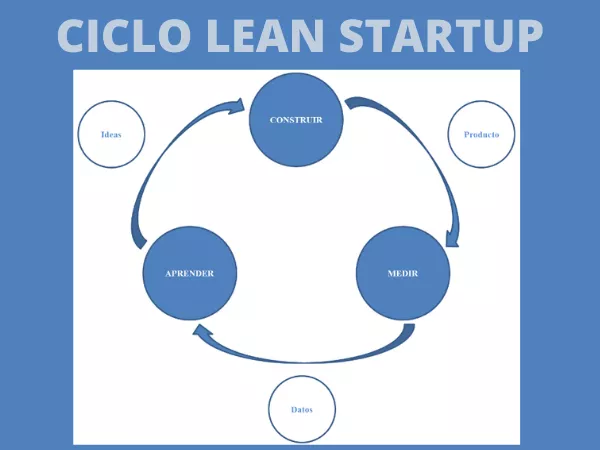
Figure 1. The Lean Startup cycle
Iteration is carried out on the minimum viable product (MVP[2]) and the build–measure–learn cycle is applied. Once the value hypothesis is clear, the first step is to enter the build phase and produce the MVP as soon as possible. Once the build–measure–learn cycle is complete, the organisation must decide whether to change the original strategy or carry on. Each iteration should build a new MVP.
Although the cycle is set out in one direction, it is in fact constructed in the other. First one decides what needs to be learned; next one proposes the system that will measure whether the desired validated learning is being achieved; and finally the MVP is built.
Lean Startup therefore requires, across the whole cycle, the support of the various parties — customers, employees, other social actors — in developing the product, as well as in solving the problem or launching a new company. Developing the MVP is not feasible without the involvement of these stakeholders, who will use a co-creation strategy to reach results more efficiently and more effectively, avoiding development work that fails to meet customers’ requirements as a whole, and saving costs.
In this way it is not the organisation that carries out activities to look after its impact on customers. What is proposed instead is that the various actors take part in this process of co-creation, so as to define how they are affected and the best way of regulating how an organisation conducts and manages itself towards the outside world.
Despite the varied literature on CSR, both academic and from organisations themselves, this approach — in which customers are taken into account from the outset in developing the various actions and measures an organisation should take to manage its relationship with its surroundings — has not been adequately addressed. Bringing in a strategy such as co-creation and a methodology such as Lean Startup is a novel point of view, and one that deserves attention.
[1] Horizon Europe. The EU framework programme for research and innovation (2021–2027), with a budget of roughly 100 billion euros.
[2] The minimum viable product (MVP) is the version of a new product that allows a team to gather the maximum amount of validated learning from its customers with the least effort.
Lecturer at CMI, Chemical Engineer and PhD in Statistics and Operational Research