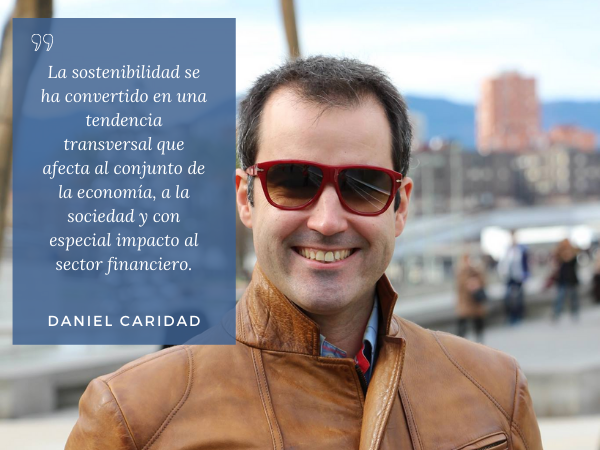
An interview with Dr Daniel Caridad López del Río, an expert in risk valuation models and sustainable finance. He currently heads corporate risk at the BBVA group and is academic coordinator of CMI’s Master’s in Sustainable Finance, as well as a lecturer and researcher on the master’s programmes in Sustainable Finance Management, Corporate Social Responsibility and Sustainability, International Marketing Management, and the Responsible MBA.
Recent months have brought a series of forums, meetings and conferences examining social responsibility, sustainability and the circular economy — ideas appearing more and more often in the mass media. But what does bringing sustainability into finance actually mean? Can one think of increasing a company’s profitability while at the same time advancing sustainability, inclusion and equality between people? To get some answers, we interviewed an expert in the field.
— What do we mean when we talk about sustainable finance?
— Sustainability has become a trend that cuts across everything, affecting the economy as a whole and society, and with a particular impact on the financial sector. Any progress here demands a deep knowledge of regulatory trends, of best environmental, social and governance practice, of reporting obligations, and of the financial valuation of traditional and sustainable products alike.
More and more companies are investing in projects that try to minimise environmental impact, or to advance social and good-governance criteria.
And there are more and more investors, too, trying to square their profitability objective with the wish that their money should serve to improve the environment and society.
So sustainable finance means that environmental, social and good-governance factors are taken into account in the investment decision-making process. All of it is known collectively as ESG criteria — environmental, social and corporate governance.
This new way of understanding finance needs to bring with it a cultural change, one that will gradually adapt to meet the demands of a public that is increasingly aware. Sustainable finance looks after the long-term sustainability and viability of the company itself.
— Why are these criteria starting to be taken into account? Why does it matter now?
— Beyond the importance it has had over recent years — and particularly since the Paris Agreement of 2015 on reducing greenhouse gas emissions — we are currently living through a moment marked by uncertainty, because of the crisis the COVID-19 pandemic has produced.
In that context we cannot forget humanity’s project, the 2030 Agenda. In September 2015 world leaders adopted a set of global goals to eradicate poverty, protect the planet and secure prosperity for all, as part of a new agenda for sustainable development.
That is why finance matters more today than ever. Sustainable finance has that “green” component, which is very important — combating climate change, reducing polluting gases — but it also takes in social aspects, with the aim of encouraging economic models in companies that respect human rights, social justice and good governance, among others.
So this is the moment to set strategies capable of containing or softening the effects of future crises. We must not devote ourselves solely to economic growth; we must also look after health, reduce greenhouse gas emissions and work for equality — which in turn can protect the economy from episodes of severe financial instability.
— Does moving into this way of thinking mean companies lose profitability?
— Clearly, every financial strategy should include — whatever the company’s size, moment, sector or reach — classic financial criteria such as profitability, risk and liquidity, and also a set of extra-financial criteria such as environment, society and governance. That is to say, what should be assessed is not only financial return, but long-term viability and sustainability.
What this kind of strategy involves is a more holistic view when taking decisions, since the concern is not only financial matters but the sustainability of the company itself. At first sight these two notions may seem contrary to one another, but it is not a matter of giving up profitability,
but of making that profitability sustainable over time — a longer-term view, against the classic tendency towards the short term.
In socially responsible investment, for example, most studies show returns at least as efficient, in risk-return terms, as traditional investments.
— What would you say are the first steps a company should take in making the transition towards this kind of responsible investment?
— When people talk about sustainable development in companies, they tend to turn their gaze towards large ones, possibly because those are seen as having resources enough to carry out the changes and actions a sustainable philosophy requires. That view is entirely mistaken, and it does not follow the parameters set by the major global organisations. The United Nations, in September 2015, adopted a set of goals — the SDGs — to end poverty and guarantee prosperity.
The part small and medium-sized enterprises play in the global economy is essential, and their contribution to progress on the Sustainable Development Goals is therefore vital.
A sustainability strategy rests on the survival of the business, and sustainability offers both threats and opportunities where long-term success is concerned — something that should not be overlooked. Sooner or later, companies will have to embed sustainability if they want to remain companies at all.
Monitoring companies’ sustainability measures is therefore essential. Demands for action can come from governments, from consumers, from employees themselves or from customers. While larger companies have already had to start accounting for themselves, smaller ones will have to do so in the not too distant future — so the sooner they begin, the more they will secure their future viability.
— What do current regulations tell us about this?
— Regulation should be a lever for bringing this kind of awareness to companies. There are parameters that oblige every company, whatever its size. It is true that what large companies have are obligations to report on that sustainability. Smaller companies do not yet have that obligation, which is why we always look more at the large ones, since they are the ones giving us information — but small companies are subject to the same rules, on controlling greenhouse gases for instance, so they should not be distracted. What exists for large companies is the legal obligation to provide information.
— For those in the phase of drawing up a business plan, or who have recently launched a company or organisation, what would the first “green lines” to bear in mind be?
— First I would tell them that being sustainable is not tied to spending resources or to taking one particular action, since this is not a passing fashion that will benefit you for a given period. It is genuinely a new era of thinking, in response to the profound natural changes now taking place.
Sustainability should be seen as a change of thinking and of philosophy, one that has to begin at the very top of the organisation chart and run all the way to the base.
So the first piece of advice for anyone wanting to commit to sustainability is to believe in the concept and in what it ultimately achieves.
Those at the stage of shaping a business plan should bear in mind that we can develop small practices that involve no excessive or quantitative complexity. We can establish and enforce strict non-discrimination policies, for instance; or train and employ members of the local community; or set a zero-tolerance policy on all forms of violence at work, verbal abuse included.
We can also decide to work with sustainable suppliers and third parties, prioritise energy efficiency across the whole operation and, of course, comply with the law and try to meet international standards — while requiring and supporting partners, customers and suppliers to do the same.
Finally, I think one has to be transparent and communicate what sustainable actions are being taken. Even though it is a legal requirement only for large companies, small ones can adopt it too, and the more transparent they are and the more they communicate, the better for their business.
— You mentioned a new era. Where do you think this cultural change is heading?
— While sustainability and economic development seemed entirely incompatible concepts, the philosophy of the circular economy has ended up bringing both ideas together.
The circular economy is a new paradigm of sustainability and represents a change of model — of production, of consumption and of distribution — within a framework of sustainability.
That calls for strategies of change in production, in consumption and in the distribution of resources, with the aim of not exceeding certain thresholds of load, and of avoiding processes that cannot be reversed.
We live in a time of great economic, energy, urban, social, institutional and political transitions, and we have to move towards that sustainability and put the focus on development.
The circular economy rests on this new model of metabolism, a closed cycle in which natural resources are scarce, environmental productivity is increased and externalities are internalised.
The COVID-19 pandemic has accelerated this shift, and that is why we need a change in how policies and regulations are designed, and in the ways we interact.
— What would you say to professionals who are unsure, or who find it hard to take on this new way of thinking?
— At a disruptive moment such as the one we are living through, new rules and new regulations keep appearing. These new dynamics are bringing in climate factors and ESG criteria, and one of the challenges we face is being able to understand and manage them well, so that the economy can be more sustainable. And if the economy is more sustainable, so will the companies we work for be.
If we do not know these new regulations, we shall lose sight of one of the fundamental variables on which the economy of the future will turn, and so lose that considerable strategic potential.
Staying up to date and immersed in the subject is essential. It will guarantee profitability in our organisations and, above all, profitability and viability that are sustainable over time.