
In a society where social responsibility criteria matter more and more, responsible investment is now possible through ETFs.
Although ETFs are a relatively recent financial instrument in the Spanish economy, how thoroughly they have taken root in the investment community is beyond doubt. So much so, in fact, that we already have examples of ETFs which seek — or have sought — to meet investors’ increasingly pressing demand for responsible investment.
ETFs arrived in Spain in 2006, and since then the level of investment in them has grown exponentially. It is no surprise, then, that these products should be adapting to the times and, above all, to what society now asks for.
What is an ETF?
Put simply, an ETF is an investment fund, but with one or two particular features. The most important is that its units are traded like shares on the relevant stock exchange, rather than in the way other traditional funds work.
Let us take it step by step. Investment funds divide their total capital into units, a concept very close to that of shares in a public limited company. In traditional funds, those units are bought from and sold to the fund manager, the company that manages the fund’s capital.
In ETFs those units are traded on the stock exchange, which means they can be bought and sold at any time by going to the market rather than to the manager. That is why ETFs are known as hybrid instruments, somewhere between investment funds and shares.
Another notable feature is that ETFs are usually passively managed funds. This means the fund does nothing but track the performance of an index: it buys the shares that make up the index it tracks, and so achieves the same results as the index.
Why they have grown
The main reason for the growth of ETFs is the simplicity of the product and how easy it is to use. No advanced financial knowledge is needed to understand what one is investing in. And since their performance depends on that of the index, tracking gains and losses is very straightforward.
Another reason is flexibility. Being able to buy and sell units at any point in the trading day makes them attractive to the small investor, who can add to or unwind positions whenever they choose.
Diversification is also worth bearing in mind. The growth of these funds has multiplied their number in recent years, and ETFs have appeared tracking a great many very different indices. That gives investors access to a large number of markets with which to diversify their portfolios.
FTSE4Good Ibex: Spain’s responsible index
On 9 April 2008 the FTSE4Good Ibex index began trading on the Spanish stock exchange — an index comprising Spanish companies that lead on good practice and CSR. As a minimum requirement, these companies must be listed either on the IBEX 35 or on the FTSE Spain All Cap.
The index came to meet a growing need in society today: that of responsible investment. It is a fact that consumers of any kind of good, financial or otherwise, no longer worry solely about the return or the price of an asset; social responsibility criteria matter more and more.
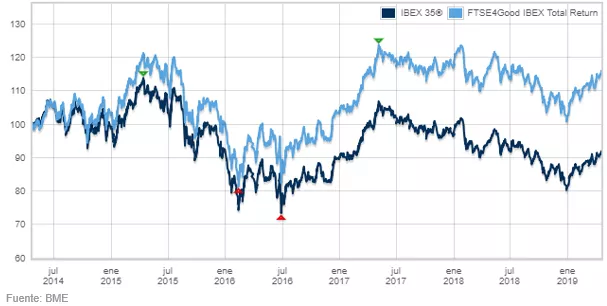
What is interesting and distinctive about the FTSE4Good Ibex is that it is not static: the criteria for including and excluding companies are reviewed periodically by an independent team of experts in socially responsible investment.
Thanks to the creation of this index on the Spanish exchange, investors can now identify socially responsible companies within Spain and, if they wish, invest in them individually. It also encourages good corporate governance and CSR practices among listed companies.
The FTSE4Good Ibex ETF
Six months after this responsible index was created, BBVA brought to market the exchange-traded fund that would track it, the FTSE4Good Ibex. Its units began trading on 1 October 2008.
The ETF’s life, however, was not a long one. On 15 October 2010 its units were suspended, which is to say they could no longer be bought or sold for a certain period. That period ended on 26 July 2012, the day the fund ceased to exist.
Removing an ETF from the market is a private decision taken by the fund’s own manager, so there is no official version of why it disappeared. The most likely cause was the poor return the index was delivering at the time.
It is worth remembering that between 2008 and 2010 Spain was in the depths of an economic crisis which, of course, affected the financial world as well. The fund began delivering very low and even negative returns — not because the index was badly composed, but because of the general state of the economy.
In short, ETFs are a widely used tool among experts in financial markets and beginner investors alike. Their growth since arriving in Europe has been exceptional, essentially because they are so easy to access and so simple. What is more, ETFs made up of companies meeting responsible criteria are becoming increasingly common on European exchanges. The FTSE4Good Ibex ETF on the Spanish exchange is one example, but funds of this kind exist on most of the exchanges of Europe’s major economies. That is a mark of the importance social responsibility criteria are acquiring in international economic life today.
You may also be interested in:
Why CSR and sustainability are now unavoidable
Corporate social responsibility: beyond volunteering and philanthropy